
Inflection Points
a life
By Tony Edwards
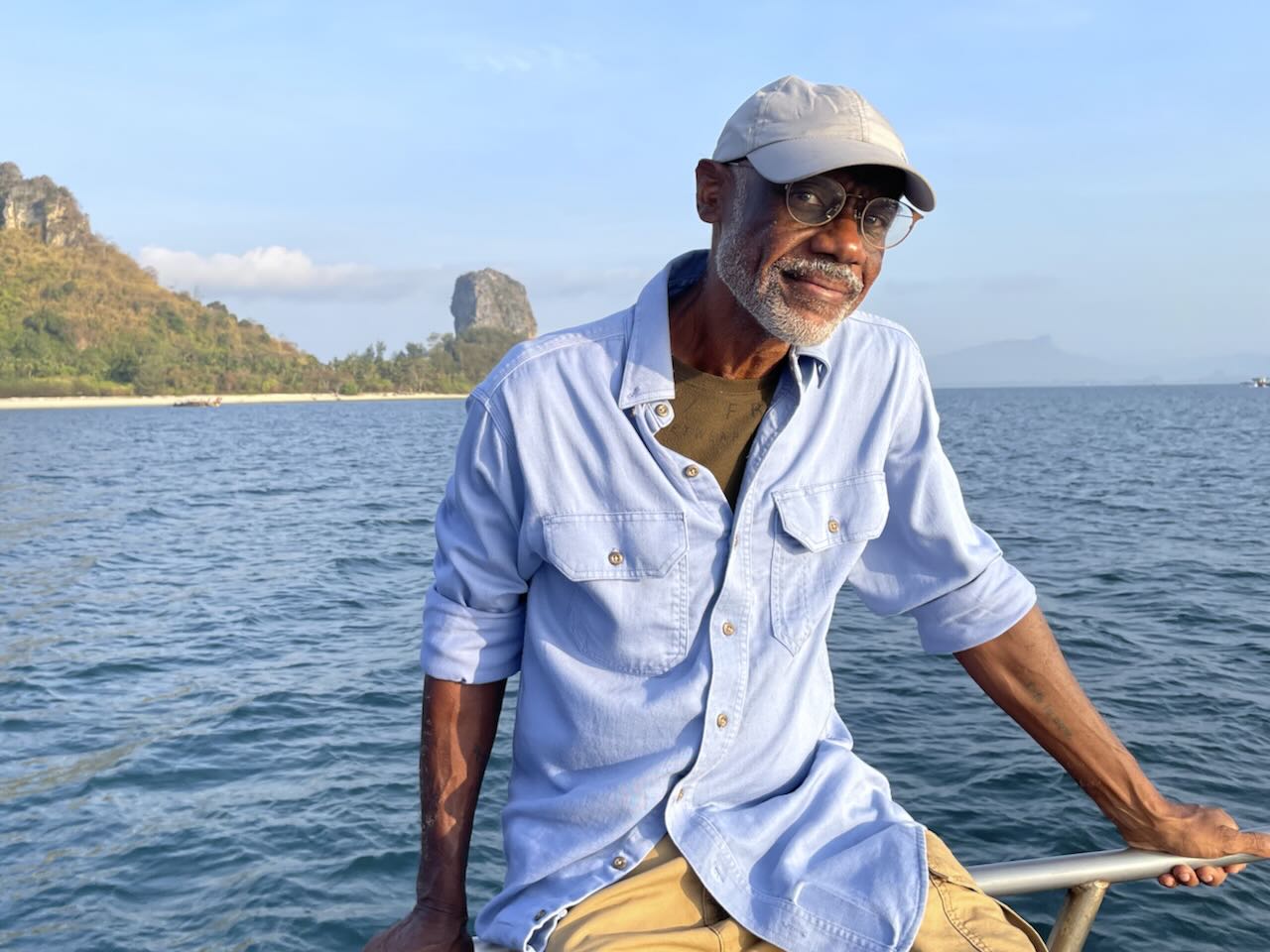
One morning, I had just finished my spin class. Everyone had left except for two twenty-something women. One was another rider, the other was our spin coach. They are both from the UK. We are all friends, a bond that grew when they attended a birthday karaoke night at my last house last year. We also share the experience of living as foreigners in Phuket, Thailand.
They chatted cheerfully about all the things and the topic of dating came. One of them is Black. She said that she had dated all types of men. They asked me if I had ever dated a white woman. “Yeah. In fact, I’ve never had a Black girlfriend.” They were shocked! When they asked why, I said, “Well, it’s a long story.”
This is that story.
I’m 71 years old. I live alone in a foreign country. My mother, father and stepfather are long gone. My wife died and I have no children. I have an older brother with Alzheimer’s who doesn’t know who I am anymore. I have no savings and I live solely on Social Security and a small pension.
And, I’m grateful.
I’m grateful to I live among the kind, friendly, hard-working and beautiful people of Thailand. The house I live in is absolutely perfect for me and affordable. Like Jerry Seinfeld’s grandparents, I live “on a very fixed income!”, but I get enough to get by with a little left over. If I lived in my hometown of Los Angeles, it wouldn’t be nearly enough to live on. I don’t know what I’d do.
I don’t work. In fact, due to restrictions on my visa, I can’t work, even as a volunteer. The upside of this means that I can pretty much do whatever I want almost all of the time. This usually means working out, capturing images, eating Thai food, riding around on my motorbike, performing in community theatre, staying at home and being on Reddit or just sitting on my patio watching the trees. When I was young, I remember seeing old people sitting on their porch and thinking, “What are they doing? That’s so boring!”.
Around Christmastime, our theatre group puts on a “panto”. A panto, short for pantomime, is a type of musical comedy stage production popular in the UK, typically performed during the Christmas season. It features family-friendly stories based on fairy tales, with audience participation, cross-dressing actors, and a mix of humor and slapstick comedy. There are many kids from the local international schools in the plays. I’ve acted in some and directed others.
But working with these kids made me realize how little I know about children because I had never had any or even been around them. And why was that? Because I was never found someone to have kids with. And why was that? One question just led to another.
Life goes in a somewhat predictable direction for most people. You grow up with Mom and Dad. Maybe they are loving and supportive. Or maybe, their relationship is rocky, but they struggle through it and stay together. But when the family is broken, it becomes an inflection point; an event which takes life in a different direction. Sometimes, the inflection point is sickness or an injury. A gain or loss of funds. Meeting or losing a life partner.
I decided to try to find the inflection points in my own life, to see if I could plot the path from South Central Los Angeles to Phuket, Thailand. I wanted to be specific, to find those moments in time when everything would change, even if I didn’t know it.
I became the old guy on the porch, thinking to myself, “Why did that happen? And why did THAT happen?” Since I have no one around to tell the story to (and my memory ain’t that great) I decided to write it down.
And, if you are reading this, you have become a small, but distinct inflection point in my life.
So, thanks.
Chapter One | Straight Outta Compton
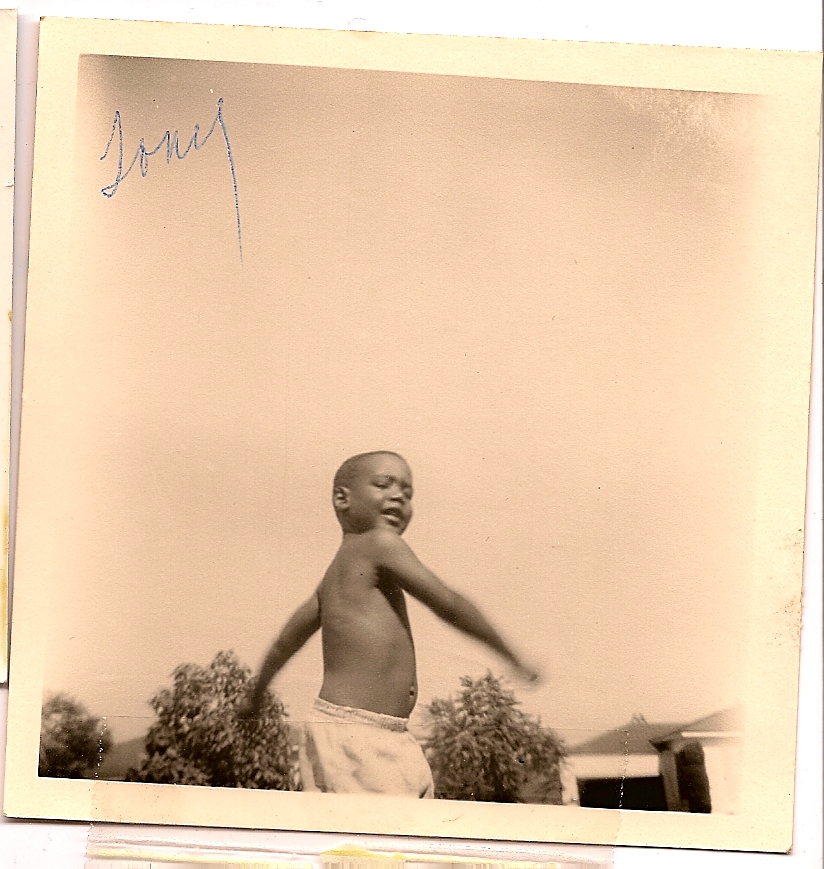
Me
1955. It was the year that Rosa Parks was arrested for refusing to give up her bus seat to a white man; the year that Little Richard changed rock and roll forever with the release of “Tutti Frutti”. It was the year that the U.S. announced plans to develop ICBMs, creating a hardening of the Cold War. In Southern California, Disneyland would open its gates for the first time. And, it was the year that Steve Jobs..and yours truly, was born.
My family consisted of my mother, Thelma Edwards, 32, my father, Fred Edwards, 46 and my older brother, Gregory.
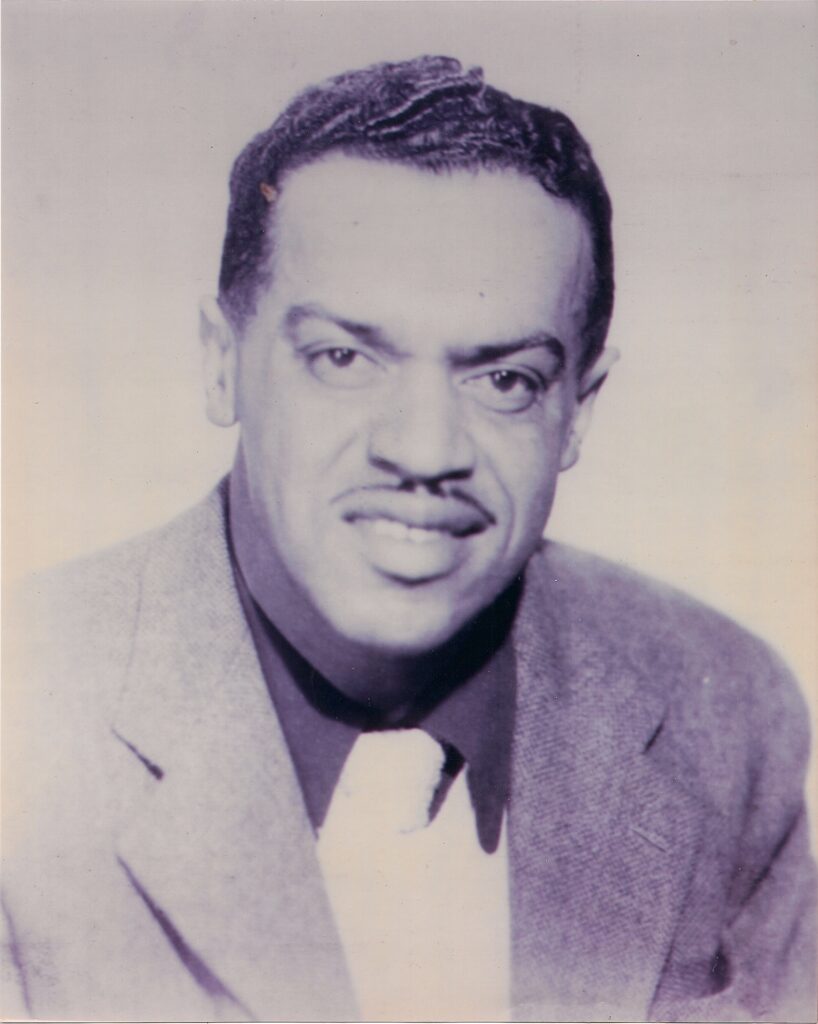
Fred Edwards
Fred
When people say, “I remember one time, my father said…” and talk about the lesson, good or bad, that they learned from his words, I can’t relate. I don’t remember a single specific thing that my Fred said to me.
Fred had had three other children with two different mothers before he met my mother, Thelma. I didn’t learn about them until I was an adult, so I was actually his fifth child.
If he loved me, he didn’t say or show it. I think that he thought that I was soft, a mama’s boy. One time, he said that he wanted to teach me how to swim, so he threw me into a swimming pool. Another time, he got mad at me for getting lost in the crowd when he took me to the horseraces at Hollywood Park. He rarely touched me, except when I would visit him at work.
Fred was a barber and he was in element when he was cutting hair. When he was cutting my hair was the only time I felt connected to him. The feel of his hands, the sound of the clippers, the smell of Barbicide. He joked with the other barbers and with their clients. There were even “Men’s” magazine that he years later would let me look at. I still remember looking in the mirror at our reflections, him standing behind me, carefully trimming my hair, me with the white smock draped across my chest. The father and son picture that stays in my head forever.
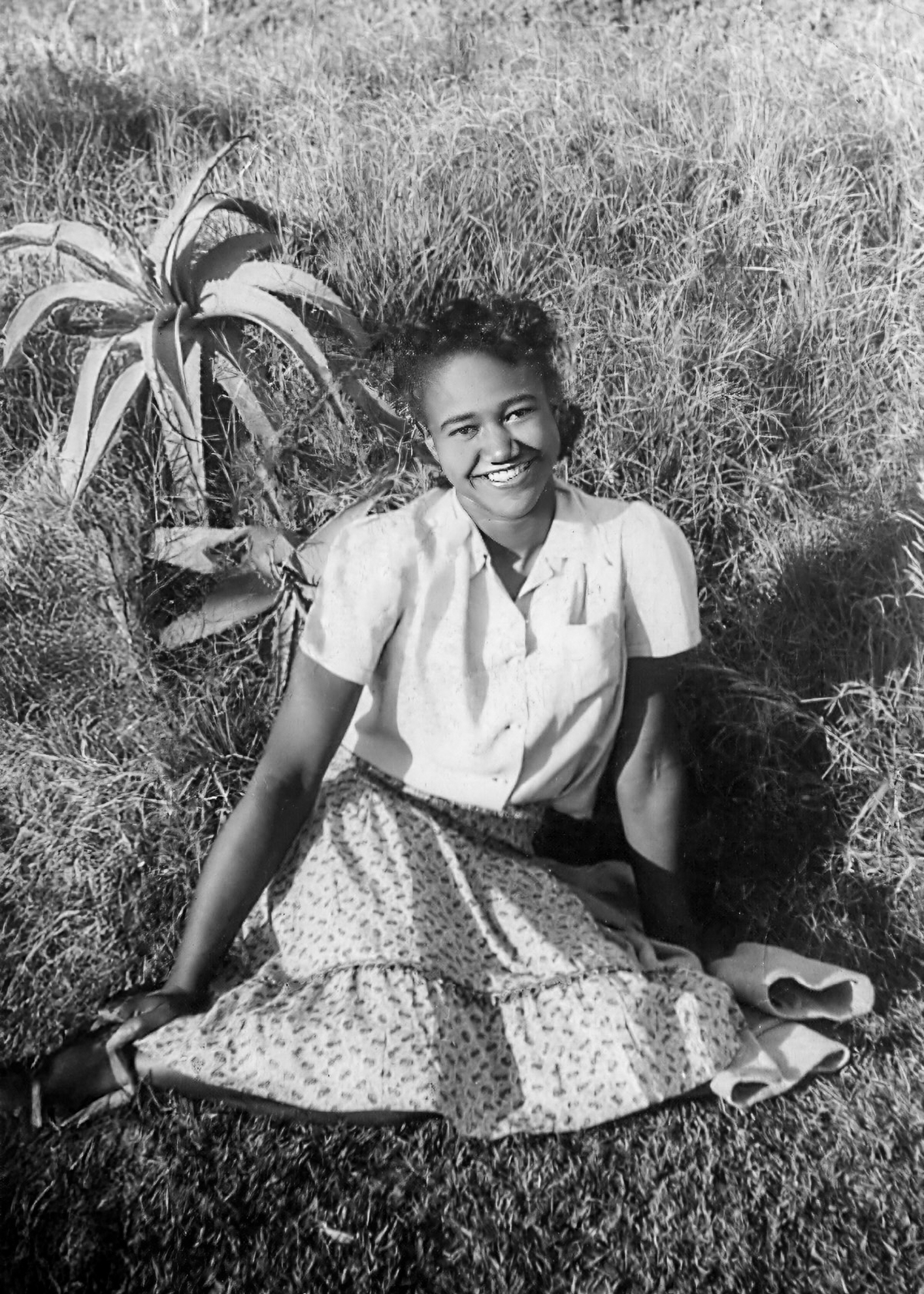
Thelma Edwards
Thelma
These days, it’s pretty easy to get information on people stretching back for years. But, try as I may, the only information I could find on Thelma Louise Hamlin, my mother’s maiden name, was information about her death. She grew up in Dayton, Ohio, but she never talked about her parents, only that she grew up with her aunt and uncle. She hated them. As an adult, I realized that she was possibly a victim of sexual abuse. Although I have a picture of my grandmother, I never met her or any of my grandparents for that matter.
Thelma did very well in school and she had a very good reason to succeed: She wanted to get out of Dayton as soon as possible. After graduating, She moved to Los Angeles to create a life or her own making. She was smart, attractive and confident. When she arrived in Los Angeles, he got a job working as an office manager for the Department of Water & Power. She was the only woman in a department of (mostly white) men.
My mother was also very well-spoken. She wanted the best for me and knew that how I spoke would make a big difference in I how was perceived, especially by white people. She was proud, I think, of the advances she had made in her employment. She wanted the same for me. Consequently, she was constantly correcting my grammar. “Not ain’t, isn’t!”,”Not ’cause, because!”, she would say, constantly correcting my speech. I have her to thank for that. It would help me in the future…and, in a way, hurt me as well.
Thelma was a church-goer her entire life. But, I don’t think that she was particularly religious. I think she went to church because she loved to sing and sing she did, around the house, driving in the car and of course, in the church choir. On the other hand, church was like Kryptonite to Fred.
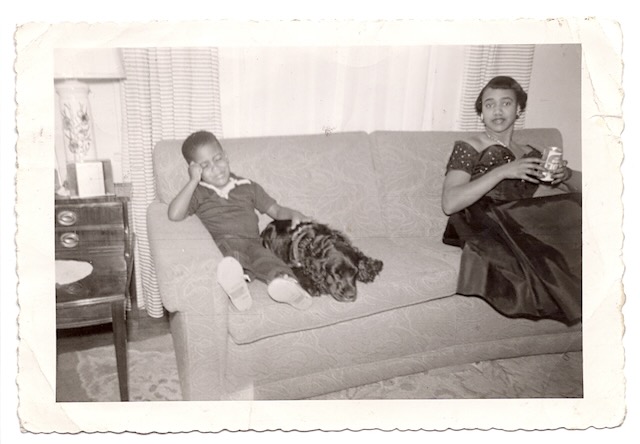
Greg Edwards
Greg
Greg was seven years older than me. This was the typical age for big brothers to beat down their younger brother and I kind of recognized that. He had his friends and I had mine. As an adult, I’ve seen how the brother relationship can change over time. There is the separation when the older brother wants nothing to do with the younger. However, as they become adults, brothers can grow back together again. Might have happened with Greg and me if we stayed together. But, it didn’t.
Straight Outta Compton
We lived in Compton, California. In the early sixties, Compton wasn’t the town that NWA was rapping about in the song “Straight Outta Compton”. Although there were not many white people living there, it was a racially mixed, lower middle class neighborhood. The corner market, Bill’s Market, was owned by a Chinese man. Our next door neighbor was Mexican…I think. Really, as a five year old kid, color wasn’t very important. I had a couple of friends in the neighborhood. But, my older brother was at the age where the last thing he wanted to do was to hang out with his younger brother. He had his own friends and my mother did not trust them.
Things deteriorated between my mother and my father. Although it was never spoken, I think that she suspected or caught him cheating. But, I do remember the tension in the house.
Then, in 1965, there was tension in South Central Los Angeles as well.
The Watts riots, sometimes referred to as the Watts Rebellion, took place in the Watts neighborhood and its surrounding areas of Los Angeles from August 11 to 16, 1965. The riots were motivated by anger at the racist and abusive practices of the Los Angeles Police Department, as well as grievances over employment discrimination, residential segregation, and poverty in L.A.
The uprising spread through South Central, all the way down to Compton. The local supermarket and liquor store were looted. Greg said that he and some friends were going to loot the stores. My mother insisted that Greg stay at home. He refused.
That was the breaking point for Thelma. She didn’t want to live in Compton anymore and she didn’t want her kids exposed to the rising level of gang activity there. Fred, the other hand, had gone into business with two partners. They opened a barber shop in a local shopping center. She wanted to move. He didn’t. So, in 1968, they divorced. Greg went to live with Fred. My mother and I moved to the San Fernando Valley.
Looking back on this now, I can see some of the effects the split had on me, the biggest one being that after the split, I had no male role-models. I never expected to be close with Fred. But, I think that Greg and I, once we had grown up, could have been much closer. I had never been around men to observe and learn from, especially when it came to women.
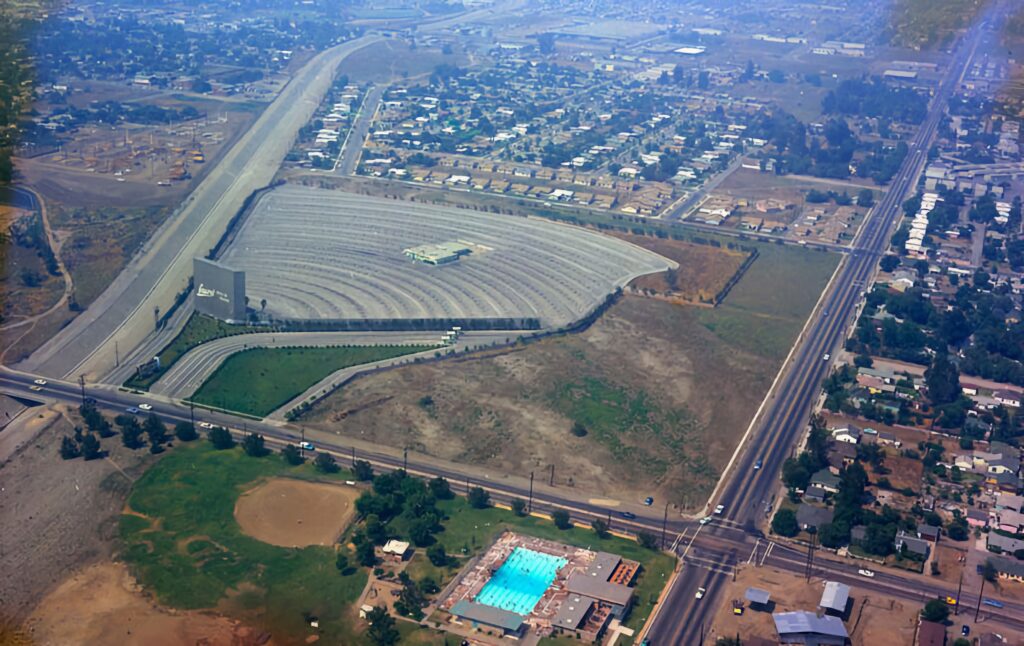
An aerial view of our neighborhood in Pacoima before the construction of the Ronald Reagan freeway that now runs behind it.
Side note: See that pool at the bottom? One day, I went there for swimming lessons. The (white) swimming instructor was trying to teach me to float on my back. I wasn’t getting the hang of it. The instructor said, “Don’t worry about it. Negroes have heavy bones and can’t float.”
I believed that my whole life until I came to Thailand and learned otherwise.
Valley Boy
I clearly remember making the drive from Compton, through the Hollywood Hills and across the expansive (and hot!) San Fernando Valley. My mother bought a house in the town of Pacoima, at the near North end of the Valley. Seventy-five percent of Pacoima’s residents were African Americans in the 1970s, although the area is largely Latino now. Comedian Johnny Carson, often joked about the city studio where his shot was shot, calling it “Beautiful Downtown Burbank”. But when he wanted to joke about a place where poor people lived, He used Pacoima.
My mother got a great price for our house because they were building a section of Ronald Reagan freeway right behind it. Our street, Paxton Street, cut through the middle of town. My school was within walking distance. The walking route to school wound it’s way through a field with an abandoned aircraft part storage shed, along a concrete “river”, along the railroad tracks next to San Fernando Road to the school, San Fernando Junior High in San Fernando.
It was a mix of mostly Latino, some Black students with just a handful of white students. As best as I can remember, I got along well with everyone. I had a teacher, Mrs. Olsen, who I particularly liked. One day, we were working on painting. I was excited about my picture. I kept asking Mrs. Olsen about the details “Is this good, Mrs. Olsen?” “What about this?” Eventually, she took me aside and said, “Tony, you need to learn to know something is good because you know it’s good, not because of what anyone else thinks.”
I was struck, not only from the advice, but that someone actually cared enough to give it to me.
I think that the other teachers were struck by my speech as well. They didn’t expect someone from Compton to sound like I did. I think this is why, when I decided to audition in the school play, I got the part: the role “Hansel” in a production of “Hansel and Gretel”. Gretel was to be played by a girl named Debbie, who looked exactly like you think Gretel looked. I even asked the teacher in charge, “Is it strange that I don’t look like a Hansel?” The teacher said “No, you’ll be fine.”
We did the show and it went well. More importantly, I made a friend. There was nothing remotely untoward in my friendship with Debbie. We would hang out a school together. A couple of times, I went to her house. That was a problem. One day she told me that we couldn’t see each other anymore. “My father told me that if you ask why, just say that he is a member of the John Birch Society. I didn’t even know what that was.” When I asked my mother what it meant, she said “It means stay away from Debbie.”
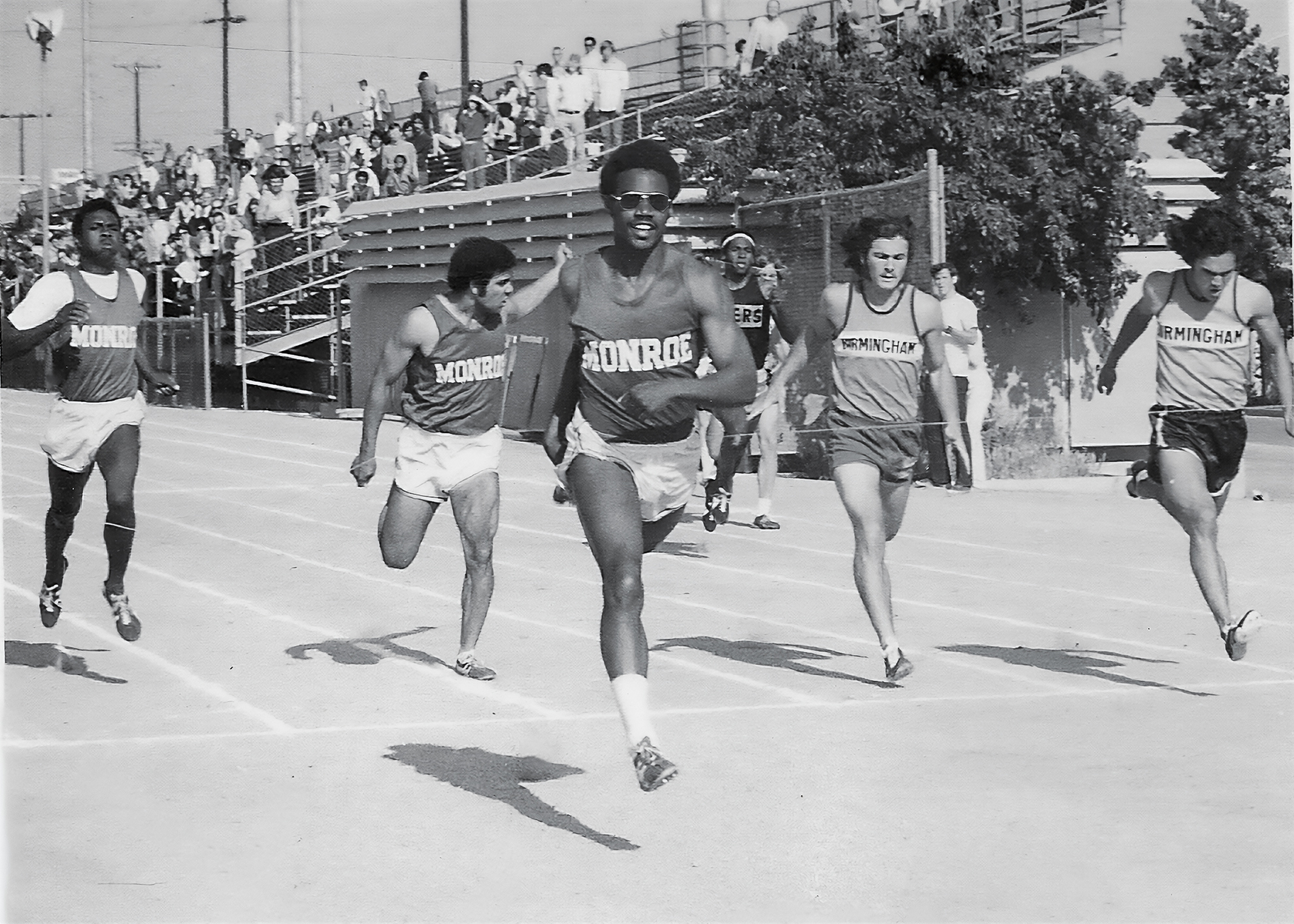
Winning the 100-yard dash
In 1970, I attended James Monroe high school in, what was then known as, Sepulveda, California. At the time, it was the largest high school west of the Mississippi river. My first year, I was one of two or three black students. By the time I graduated, there were about 15 of us.
From the beginning, I don’t think I had any problems with racism. At least to my face. Everyone was friendly. And, again, I think the way that I talked, had something to do with it. I was on the track and football teams. I sang in the vocal ensemble and performed in the musicals. I was even in the modern dance class. It wasn’t because I was gay. It was because I could be around girls in leotards. I mean, how could I be gay and on the football team, right? RIGHT?
I hung out with the dancers and the actors and the singers because I had something in common with them; they were all weird as well. All of the people that I hung out with outside of school were people that I knew through theater or dance. I met my first (and only) high school girlfriend, Renata, when we performed together in a dance concert. We even made out once in Reseda Park. But, again, her parents found out and forbid me to see her. She didn’t say why. She didn’t have to.
A few years back, Monroe had a 50-year reunion. I had been in Thailand for awhile and knew that I wasn’t going to be there. I followed the event on Facebook. People were posting pictures from the school days. There were pictures and pictures of kids from football and track teams and cheerleaders having fun at a party, a poolside barbecue, hanging out on Van Nuys Blvd. I wasn’t in any pictures and I realized that it was because never invited.
The theater people were different, though. We were proud weirdos.
One day, we had a track meet against Locke High School. Locke was one of the reasons that my mother moved us. She didn’t want me to go Locke. It was one of the most dangerous high schools in terms of gang violence at that time. And there I was, having no contact with other Black people my age. I was worried about what they would think of me being the only Black kid on the other team. That question was addessed before the final event; the 400 yard relay. I was the anchor for the Monroe. A young brother in sunglasses, wearing a long leather jacket in the afternoon heat, walked across the field to our side of the track. He walked up to me and said, “You best not win this race. A’ight?” He stared at me for a moment, then walked back to the other side of the field.
I really didn’t know what to do. What could I do, the race was about to start. At the starting gun, both teams were about even through the first three legs of the race. I stood next to the Locke anchorman we both waited to get the baton. I got mine first and as I turned, I felt something bounce of my heel. It was the Locke baton. They had dropped it and it hit my foot. We won, but I was super worried that they would think I kicked it out of hand. I didn’t wait around to find out.
Somehow, the weirdness of being at Monroe started getting to me. I felt isolated often. This was the early seventies, the time of the Jesus freaks, a young Christian movement that was sweeping the country at that time. The was a church right across the street from Monroe. Someone invited me to come to a meeting. I became a Christian. I was looking for fellowship and thought I’d found it with these young people.
Not long after, I visited the church that most of friends attended. It was huge, one of the first mega-churches. And I got the vibe that they…didn’t welcome the stranger. Christianity, for me, didn’t take.
I tried to ask my mother about it. After all, she was the one who went to church every Sunday, although I think is was mostly to sing and socialize. I can’t remember what it was exactly I wanted to ask her, but it was about my feeling of confusion of our family. She did want to talk about it. Frustrated, I called my brother and asked him what he thought about seeing a therapist. This was the first time I ever reached out to him for help. His words were burnt into my memory.
“Therapy? You best stop trippin’.”
That was it. That was the moment that I realzed that I was going to have to figure life out on my own. It turned out that Mrs. Olsen was spot on.
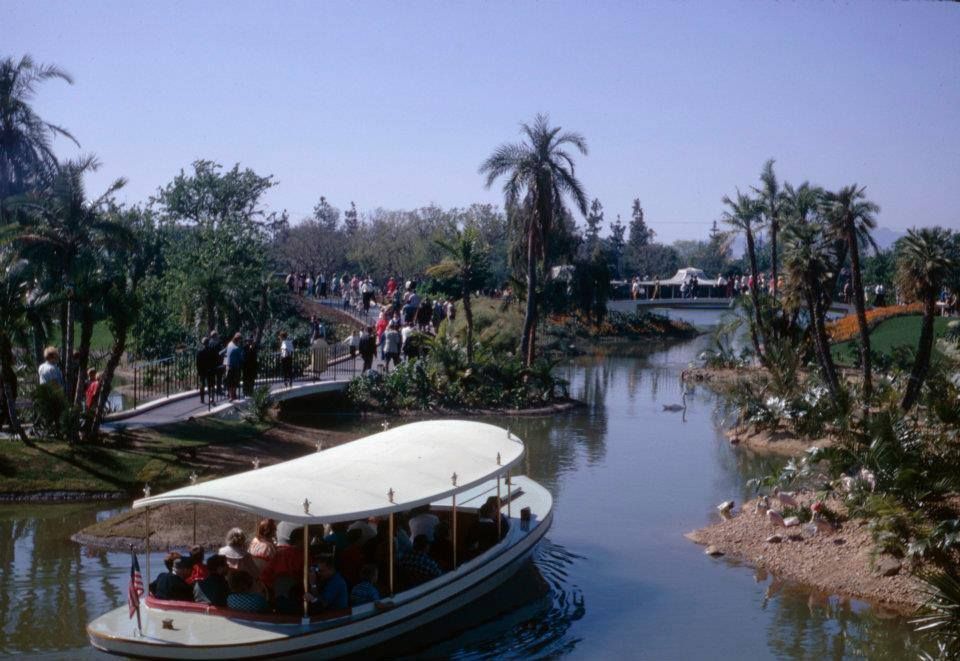
Boat Cruise at Busch Gardens
I had had a couple of common high school jobs before what I call my “amusement park phase”. It started as a being a boat tour guide at Busch Gardens Los Angeles. Later on, I would be a costume character. Then (perhaps as a nod to “Hansel & Gretel”) a Schuhplattler dancer. Not long before Busch Gardens closed permanently, there was a stage that featured a Showboat motif. We were hired to put on a mini musical, complete with an “Ol’ Man River” solo (not me).
After Busch Gardens was closed, I worked at my second amusement park, Magic Mountain, about 10 miles north of the Valley. I briefly worked at Disneyland as a parade dancer, but stopped working when I realized how much it would suck drive to Anaheim all the time, much less live there
Fortunately, I fell into a job which would not only be fun, but where I met many great friends. I was a tour guide at Universal Studios Hollywood.
My mother once said “Why is it that you can’t remember anything I tell you to do around the house, but you can remember every line from every commercial on the television. Maybe that’s what you need to be doing.” I think she regretted saying that but she knew it was the truth.
Chapter Two | There’s No Business Like Show Business
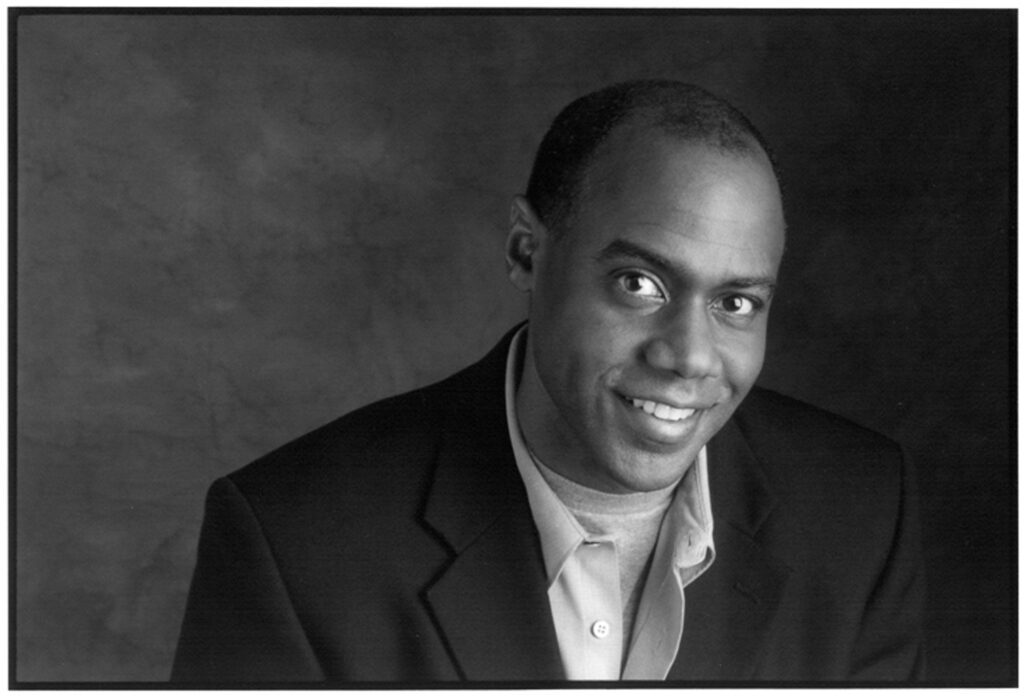
After high school I was accepted into Occidental College, a small, but respected liberal arts school nestled in the hills between Glendale and Pasadena. I studied Speech and Drama.
At this point in time, my mother was working for the Los Angeles, Board of Education as an office manager. She worked at a school, whose principal was married to a comedian named Avery Schreiber. The comedy team of Burns and Schreiber was well known at the time, having made many appearances on late night talk shows. One day, my mother said that she had talked to her principal and the principal had set up a meeting with me to meet Avery for lunch on the backlot of Universal Studios where Avery was doing a guest spot on “Sanford and Son”.
Avery was really kind and funny. He said that he would present my picture and resume to his agency; the William Morris Agency. At that time. WMA was the largest in town. Only stars filled their roster. So, when they basically laughed in my face over the phone, I wasn’t really surprised, or even bummed out.
I got cast in a small theater production of “One Flew Over the Cuckoo’s Nest”. I was excited because it was the first time I would get paid to act. I played one of the aides at the mental hospital. The role of Randle McMurphy was played by Jonathan Banks (who would go on to play Mike Ehrmantraut in the hit television show, “Breaking Bad”). He had just moved out from New York. Another actor in the show said that her commercial agent was looking for people. I submitted my picture, met with them and they signed me. My first national commercial was for A&W Root Beer “…with that “Frosty Mug Taste!”
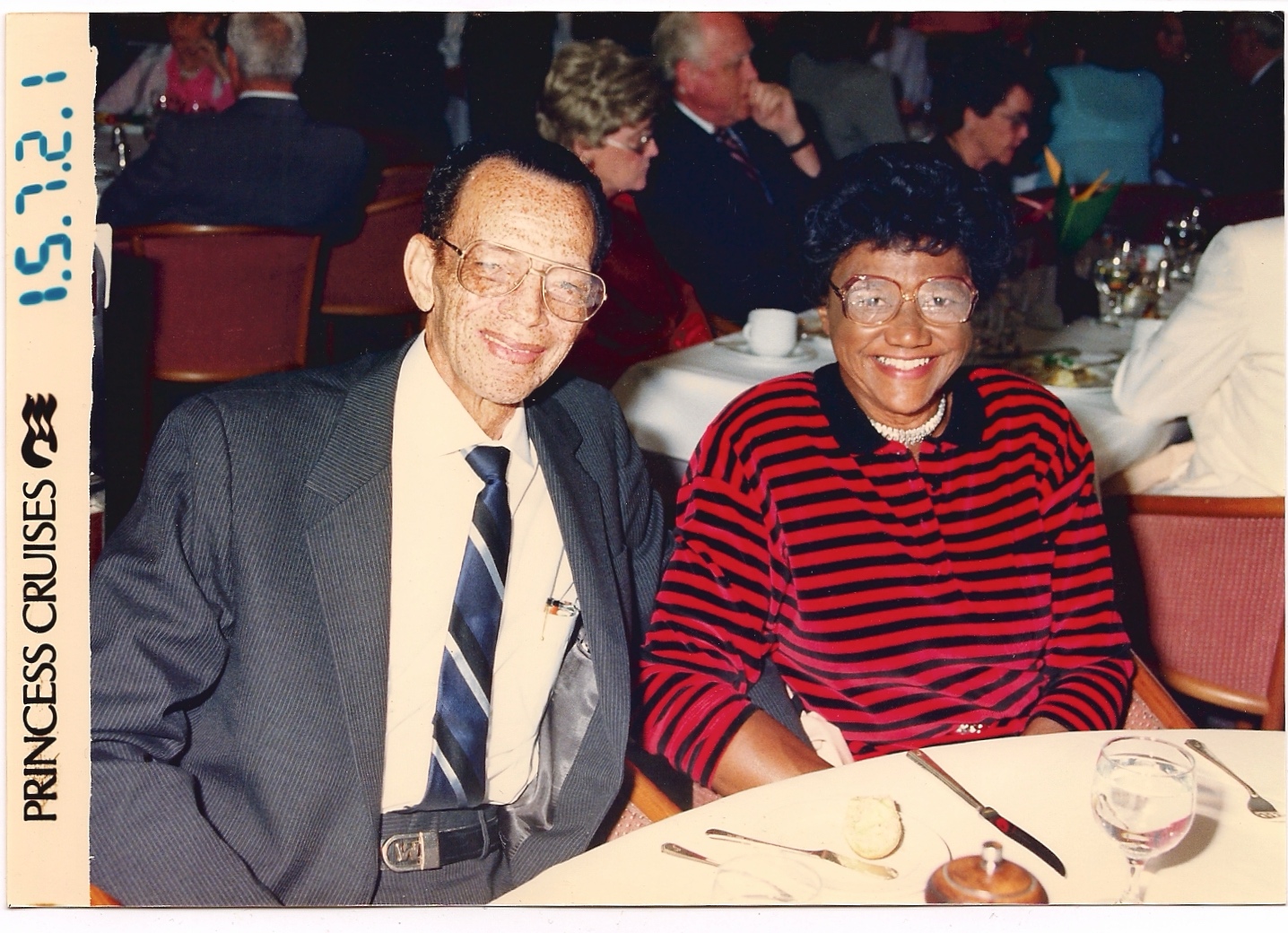
In 1976, Fred died of cancer. I had barely seen him or my brother Greg in the years before Fred’s death. I made my way alone from the Valley to the mortuary in South Central where the service was to be held. My mother wasn’t there and my brother did not want to speak, so the family asked me to say some words “since you’re the actor”. I don’t remember what I said, but it was awkward.
Not long after my father’s death, my mother reunited with the man who would become my step-father. Wayman Westfield had known my mother before she married Fred. In fact, the three of them were friends. The two men could not have been more different. Fred was handsome and gregarious. Wayman was…well..homely and shy. He was tall, but very thin. Light-skinned and covered in freckles. A church-going man who played the piano and organ for his church. He had loved my mother forever. He was kind and gentle, but he just couldn’t compete with Fred.
Now that Fred was out of the picture, he had a chance with Thelma. And, my mother, coming of the experience that she had with Fred was ready for a different kind of man. Unfortunately, Wayman had his own set of demons. He had severe body issues because of his being so thin. I’m not sure if he and my mother ever had sex. He was also an alcholic, but he was never a mean drunk. He was just sort of…checked out.
I wish he could have, but I knew that he could not be a father to me. I know (well, I guess) that is a very hard thing to do. Wayman just wasn’t up to it. But, I was glad he was there for my mother. The two were best of friends. They went to church together. They went on cruises and travelled all over.
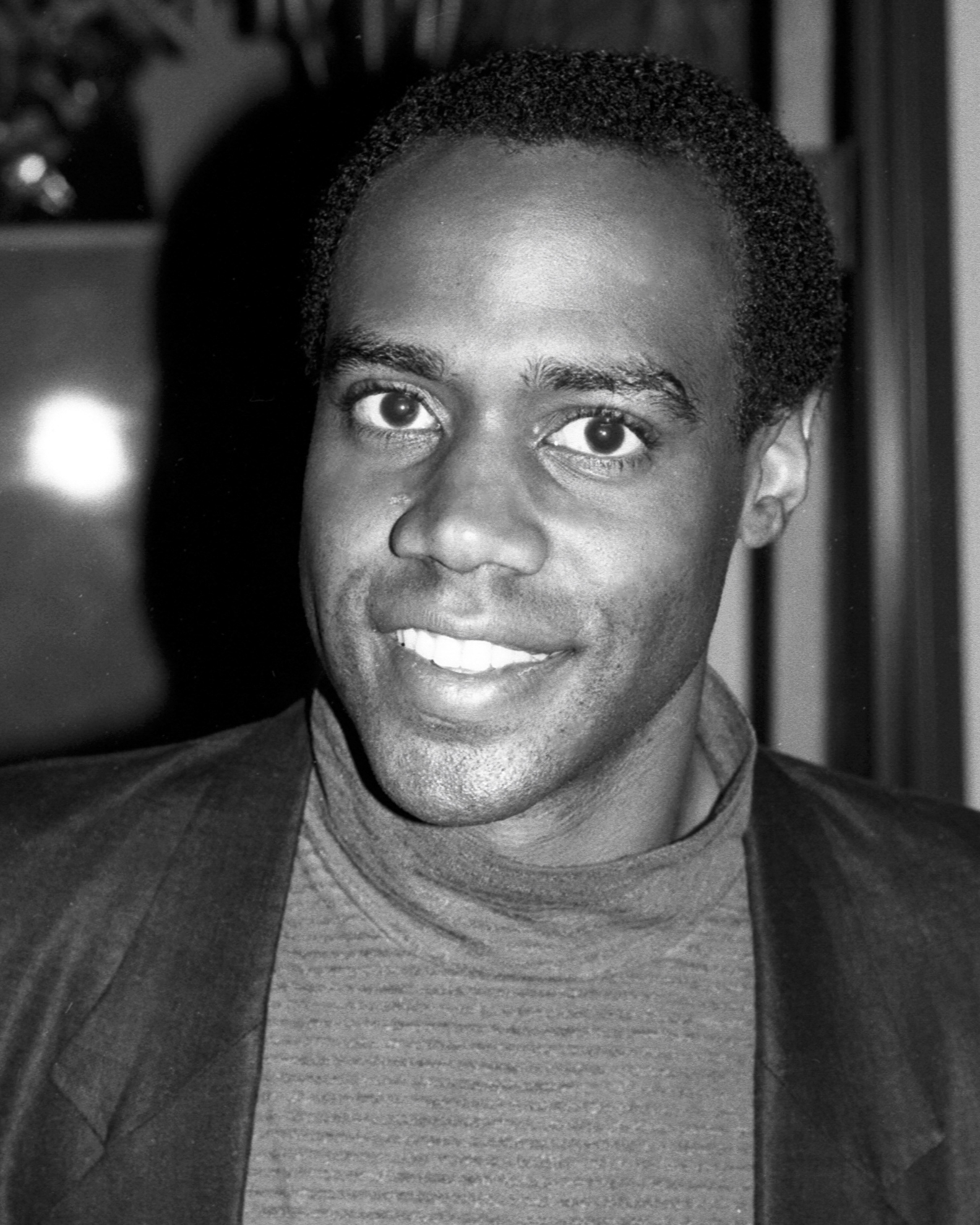
“Your MC” for the evening.”
In 1982, I wasn’t quite ready to rely solely on my commercial earnings, so I kept my day job as a tour guide at Universal Studios. Several of the guides attended a class taught by a man named Harvey Lembeck and they invited me to come with and check it out. Harvey had a group of very funny people in his class, including some stand-up comics. After class, they would go the World Famous Improvisation comedy club, have drinks and work on material. I started going along and watching the comedians. Our class was on the same night as the Open Mic show, where anyone could sign up and perform. I would watch these brand new comics try their jokes and as I watched, I thought to myself, “I could do that”.
The next week, I signed up with the MC (Master of Ceremonies), Larry, a young Black man, to go on. I did my three minutes. I did not suck. I went back the next week and asked Mark (Lonow, co-owner on The Improvisation) where Larry was so that I can sign up. He said, “Larry’s not here anymore…do you want to emcee the show?”
I did MC the show. I didn’t know it at the time, but Mark had been watching when I went on the week before. He was struck by the fact that it was only my first time trying stand-up. Mark offered me a job working at the Improv. The job included being the main MC for the club. From time to time, I would also sell tickets and do seating. I also played the other Improv clubs and appeared on the “A&E’s An Evening at the Improv” and the “MTV Half-Hour Comedy Hour”. For the next eight years or so, I worked at the club, introducing the very top names (except those exclusive to the Comedy Store, the rival comedy club in town) in standup comedy, from Robin Williams to Jerry Seinfeld.
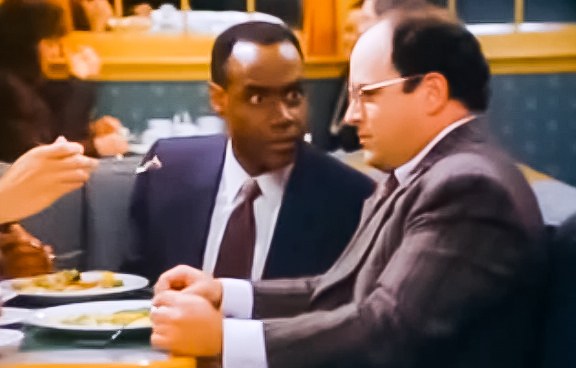
“If you’re one of us, you’ll take a bite.”
The Jerry Seinfeld Story
Jerry had recently moved out to LA from New York to start work on his new TV, “Seinfeld”. He would often come into the club to work on the bumpers, segments at the beginning and end of the show where fury was doing stand-up. One time he was doing a joke about flying.
“I fly a lot and I always wonder, does the airplane have keys? And, if so does the pilot ever forget to bring them to work? Does he ever get on the intercom and say ‘Ladies and gentlemen this is your captain speaking and…I’m so embarrassed…I left the keys to the plane at home. I can see them. They’re sitting on top of the dresser.”
I had listened to literally hundreds of hours of the best comedians in the world as the MC. I got to learn what was funny and how to create jokes. So, when Jerry did his joke, I came up with what I thought was a perfect tagline for it. But also, I understood that many comedians didn’t want anyone to contribute to their act. I respected that but the line was so funny, I decided to jot it down on a piece of paper and give it to Jerry when he got off stage. He looked at it and simply said ” Hmm. Yeah. Thanks.” A while later, I had another idea for Jerry, but again I hesitated in giving it to him. They were great lines, but I didn’t want to bug him so I called him at the Seinfeld offices and left him a message on his service.
At the time I was living in Studio City with my girlfriend, Dena. One day I came home and Dena excitedly told me that there was a message on the machine from Jerry Seinfeld. It said “Hi Tony, Jerry Seinfeld here. I got your message and, yeah, keep those ideas coming. We’re all in the same comedy life boat here”.
On May 6, 1992, Dena and I were watching Seinfeld on the television. The episode was entitled “The Keys”. It was the end of the episode and Jerry was doing a stand-up bit. He did the joke about the keys for the airplane and… ended it with the line I gave him, “You see the technicians all running underneath the plane; you think they’re servicing it, but they’re actually looking for the magnet “hide-a-key” under the wing. ‘Maybe he left it up there somewhere.'”
So, yeah, I was pretty blown away. But, I was also so bummed up by the fact that I would never be able to tell anyone that I wrote a joke for Jerry Seinfeld that he performed on his TV show (Wait a minute, I just did!).
At that time, Dena was working at a bookstore on Ventura Boulevard in Studio City, right across the street from the studio where they filmed “Seinfeld”. One day, I was having lunch with her at nearby mexican restaurant, when I saw Larry David come in. I knew Larry from when the was on a comedy sketch show called “Fridays” and he would also perform at the Improv. He was now the writer and Executive Producer of “Seinfeld”. I didn’t want to bug him, but I wanted to say “Hi”. “Hi, Larry. It’s me, Tony, from the Improv. I don’t want to take up any of your time, I just wanted to congratulate you on the show. Keep up the great work.” Larry said, “Oh yeah, Tony. How are you doing?” He paused. “Hey, you’re an actor, right?” I said yes. “Good, I have something you might be right for for the show. Call me at the office tomorrow.”
Having been in showbiz for a while, I knew that it was very likely that nothing would come of it. Sure enough, when I called the next day, he said that they went another way but that he would keep me in mind. Oh well, I thought.
A few weeks later, my agent told me that I had an auditon for a part on Seinfeld. Normally, when this happened, you would first do a video audition for the casting director, then a live audition with the casting director and maybe a writer. At the final audition, would be for the producers and director. For my first audition, I was “going straight to producers”.
The role was “Businessman #2”. I sat in the waiting room with about six other actors, all of us wearing suits and ties. Jerry came into the offfice. He stopped and said to me, “Hey, Tony! Good to see you. Oh, and thanks for that punchline, it was perfect. See you inside.” Then, Larry David came in. “Hi Tony! I told you I was going to bring you in. Good luck!” Then, Michael Richards came in. I also knew Michael from the Improv. He smiled and gave me a Kramer-esque “Hey, Tony” and two thumbs up. I looked around the room as the other Businessman #2’s glared at me.
I got the part.
The episode, entitled “The Pie” aired February 17, 1994. In the episode, Jerry needs to know why his girlfriend refused to try some apple pie; Elaine searches for the creator of a store mannequin with her own face; Kramer starts seeing a long-nailed woman to get his back scratched. And George cheats another man to buy a suit on sale. George gets the suit (which he discovers makes the sound of rustling leaves we he walks) and wears it to lunch with his potential boss and two other businessmen. George discovers that the chef at the restaurant is the same guy he cheated the suit out of. A waiter brings complementary pieces of pie for the group saying, “The chef made it special… for you.” George turns and briefly sees the chef. Knowing what’s going on. He refuses to eat the pie. The potential boss says that the pie is delicious and tells George to try it. “Take a bike, George” George shakes his head “Take a bite. I insist”. I turn to George and say my one line:
“If you’re one of us you’ll take a bite.”
This story has an epilogue. In 2014, Jerry Seinfeld did an “Ask Me Anything” on Reddit. Someone asked him “Do you find yourself often quoting the more popular lines from the show? I use “these pretzels are making me thirsty” as often as I can”.
Jerry replied. “The only line I quote from the show (and I’ll be very impressed if anybody out there remembers this line) is “If you’re one of us, you’ll take a bite.” I find myself saying that to my kids a lot. It’s a very obscure line, but George was working at some company where they all had lunch together, and he wasn’t trying the apple pie, and the boss Businessman #2 finally says “If you’re one of us, you’ll take a bite.”
There was another African-American comic/actor who I met while working at the Improv named Robert Townsend. He and I had something in common; we were both Black comics who didn’t “sound black”. But he, brilliantly, took his experience and made a very funny movie about it, shot it with his own money (and credit cards) and cast all of the friends it. “Hollywood Shuffle” was about an actor who couldn’t get big parts in movies because they didn’t sound black enough.
I had that in common with Robert. Black actors were largely hired to play stereotypical roles and they had to sound Black. It didn’t matter if the role was a gang member, policeman, soldier, even a guy in a suit. If you didn’t sound authentic, you didn’t get cast. Well, actually, that’s not true. Leonard Nimoy cast me in Star Trek IV, but it wasn’t until later when we were shooting the scene that he asked if I could make my line reading “a little more…urban.”
I was booked as the middle act for a show in San Diego. It was a “Showtime at the Apollo” show so, unlike most other comedy shows I had done, this was three Black comics for a basically all-Black audience. I had learned from previous shows like this one, I was careful to…”curate my jokes and delivery” for this audience. But the opening act, well he sounded whiter than I did. And, he was an opening act, so, yeah, his jokes weren’t killer. But still, the audience was brutal. They didn’t just not laugh, they booed him. I did okay and the headliner of course, killed.
But driving home, I couldn’t help but think about the opener guy. I didn’t feel bad for him, I was mad for him. It could have just as easily been me a couple of years before. It was on that drive home. I decided that I didn’t have enough desire for stand-up to not be myself when I’m standing there. It was the beginning of the end of my standup career.
Larry, the guy who was the MC at the Improv before me wasn’t Black enough either. I remember one of his jokes: “I’m too white for Black people, too Black for white people and I don’t like tacos.”
Top of the Hill
Around that same time, I got cast in my first motion picture. And what a first movie to be in; “Starman” with Jeff Bridges, Karen Allen and Charles Martin Smith, directed by John Carpenter. I played a communications officer on a helicopter. It was my first time going on location, first time working with a professional crew and actual movie stars.
This was followed by small contribution to the Star Trek cinematic universe in “Star Trek IV: The Voyage Home”.
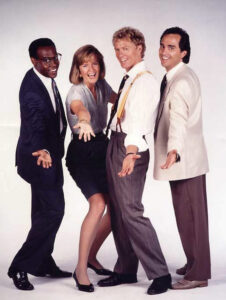
I worked on several other projects which seemed to indicate that my acting career was on the up swing; a nice role in a movie with John Travolta, “The Experts” (1989), a short scene “Star Trek IV” (1985) and co-star role in “Top of the Hill”, a TV pilot starring William Katt (“The Great American Hero”). I was excited when I heard that the show had gotten picked up by CBS. But soon after, I was told that my character was cut. So, yeah, I was pretty disappointed. But, a couple of months later, my agent got a call from the production company, Stephen J. Cannell Productions. They wanted to bring me back for a limited number of episodes.
I had a meeting with Mr. Cannell himself, where explained what he had in mind for me. I was to play one of the aides to a young, brash Congressman played by William Katt. I was in five episodes.
In the last episode, an investigative reporter discovers that I’m a closeted gay man. When the reporter refuses to keep my orientation secret, I go back to my apartment, briefly call my mother…then jump off the balcony of my high-rise apartment.
When Stephen J. Cannell, creator of “The Rockford Files”, “The A-Team”,”The Greatest American Hero” and “21 Jump Street” calls you into his office and tells you he thinks that you would do a good job playing a gay man, what are you gonna do? I jumped at the chance. Literally.
I have always looked younger than my age. That worked well for me as an actor, but, at some point, I was in a no-mans-land; young looking, but not actually young. So, TV and movies had slowed down for me. Also, since I had moved away from standup so, in 1994, I had to get a day job.
Also, I have always been an Apple fanboy. My first computer was a Mac Color Classic. When I was doing standup, I would put it in a big travel case and take it with me on the road because I couldn’t afford a Powerbook. I came across a job opening as a Mac representative in the retail segment.
The company was called MarketSouce. My job was to visit all of the Fry’s Electronics in Southern California and demonstrate Apple products. When I started. it was an okay job. The Fry’s Electronics store were wild. Each store had a different theme and the interiors looked like movie locations. But the Mac computers themselves were just…beige. Soon, though, Steve Jobs came back and along with him came, the iconic iMac G3, Airport wireless networking, the PowerMac G3. It was exciting, people had never seen tech like this before. We each got G3 PowerBooks. They gave us DV cameras to demonstrate iMovie and Final Cut Pro.
It was a full-time job, but at least the hours were flexible and I could still be able to go on auditions. Having a regular paycheck allowed me to get a reliable car (which I needed for work anyway). The extra money also allowed me to do something I had wanted to do for awhile; take acting lessons.
One day during class, my scene partner told me that she was going to participate in something called the California AIDS ride. The ride covered 560 miles from San Francisco to Los Angeles over the course of seven days.
I was into cycling and had a very nice bike which I got while working at I. Martin Imports, a high-end bike shop in West Hollywood. I had done some long rides before, including a ride from Los Angeles to San Diego. But the AIDS Ride was something new for me. I’m my life, I had never been involved with a “big thing” with hundreds of other people, a mass movement if you will. When I agreed to do the ride, it was the subtle start of another turning point.
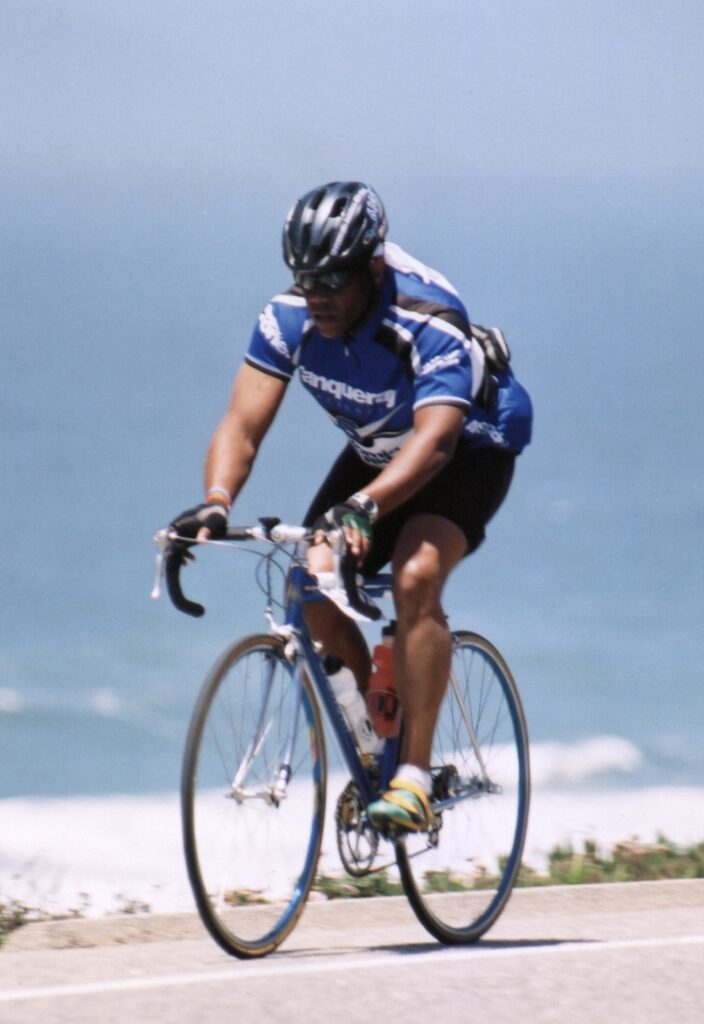
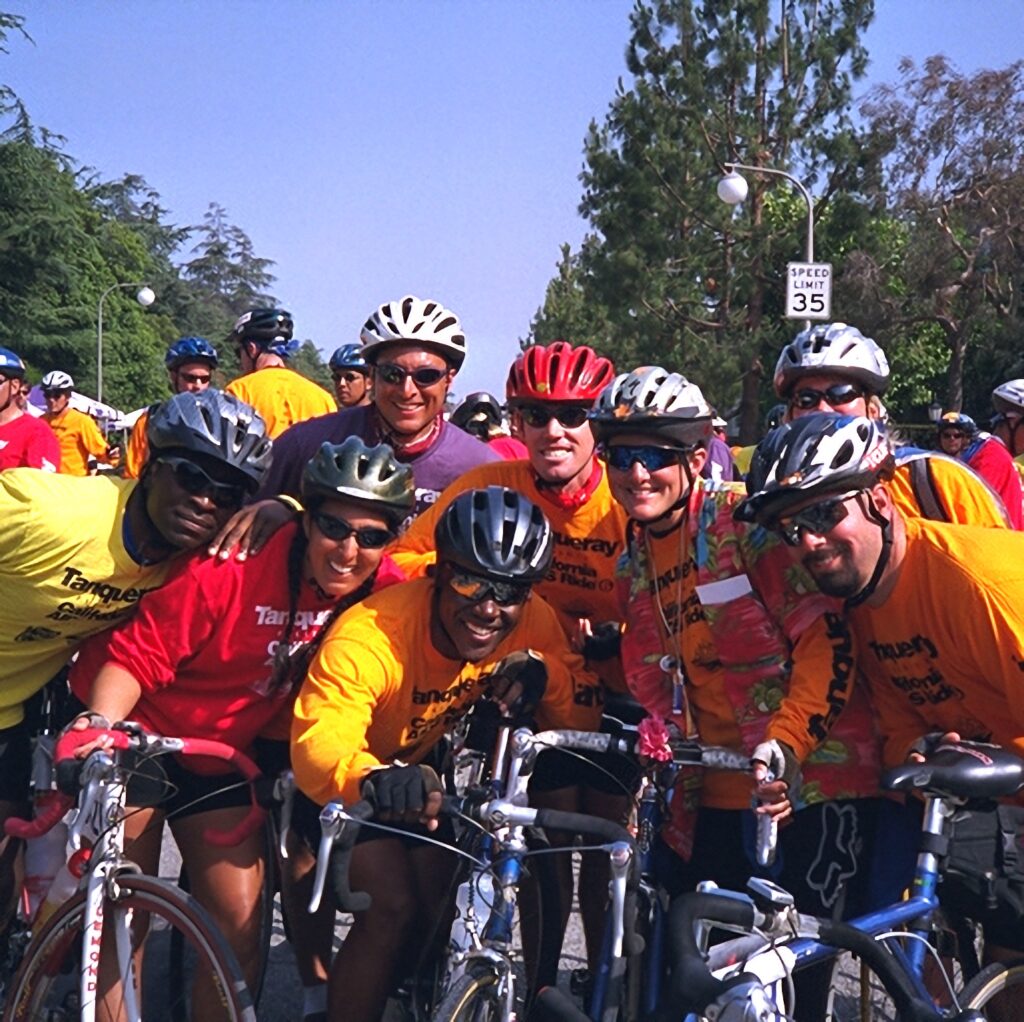
The logistics of the ride was simple. Every rider had a duffel bag which contained everything they would need for the week. We were also given a two man tent, we chose our own tent mates. We would ride all day, while our tents and gear would be transported in trucks to the campgrounds where we would spend the night.
And I had never been around so many gay people before. It was a beautiful ride and looked forward to doing it again.
I participated in the AIDS Ride in 1997 and 1998. I skipped 1999 but then, in 2000, I decided to do the ride again at the last minute. My everyone in my local training group had already found their tent mates. I asked the leader if they heard about anyone needing a tent mate to please let me know. Not long before the ride, she told me that she found someone and she arranged for us to meet each other.
Krista (not her real name) was a 26 year-old, tall, blonde, triathlete from Switzerland with a sweet smile. I was 45. God had sent me a sign that I definitely wasn’t gay. But, it was easy to see that she was interested in someone else on the ride. Still, it was nice to share and two-man tent with her for a week. At the end of the ride, she suggested that we get coffee. After some small talk I told her that found her very attractive to me, but I didn’t want to say thing because (that guy). “Oh him? No, we’re just friends. Actually, I’m attracted to you, too!”
We started dating. She was super sweet and loving and quite lovely. She was into EDM. She asked me if I had ever taken ecstasy. I said no. “All right I’m going to take you out dancing!” We went to a tiny club on Santa Monica Blvd in West Hollywood called Peanuts. We dropped in the car, then went into the club. It was dark, except for the undulating disco lights. Not only was it the loudest music I had ever heard in a club. Because I had never even been in a club before. The dance floor was packed. Krista sat next to me at a bar. “Are you feeling anything?”” No, I don’t think so. Wait a minute…” Suddenly, all of the feels came on at once. I had never experienced anything remotely like it. I went to dance and lost myself in the crowd. I came back to Krista and tried to hug her…too much. “Whoa, settle down there.”, she said. We had an amazing night. The ecstasy was amazing, but the change that happened and wouldn’t go away was from the music. I had found MY music. I remember being in Fry’s Electronics in Woodland Hills and hearing “Sandstorm” by Darude playing somewhere in the store and I had to find where it was coming from and try to keep from dancing in the aisles.
One thing that Krista wanted to do in the United States was to go to Burning Man, this crazy “thing in the desert” which I had never heard of before. She already had a ticket to go and was going to camp with her roommate. I was far too late for me to get a ticket and the time off to go. When she came back, she showed me her pictures. It looked like they both had an amazing time. She said that she wanted to go next year with me. I bought two tickets the day they went on sale.
But seriously, she was 26. I was 45. She was a Swiss citizen, in the United States on a work visa. I knew it couldn’t last. Eventually, she need to return to switzerland, to renew her visa, we both cried at LAX on the day she left. She promised she would come back. But, when we talked on the phone, I could tell that something had changed. My hopes for her return dwindled, but they were completely destroyed on the morning of September 11, 2001.
I never saw Krista again.
Chapter Three | Burning Man
2002. I had two tickets to Burning Man and no one to go with. I ran into a woman that I had dated briefly a few years back. Eventually, the conversation turned to Burning Man. As it turned out, she was going that year and camping with a bunch of established Burners. She invited me to camp with them.
But, you may be asking yourself, “So then, what, exactly, is Burning Man?”
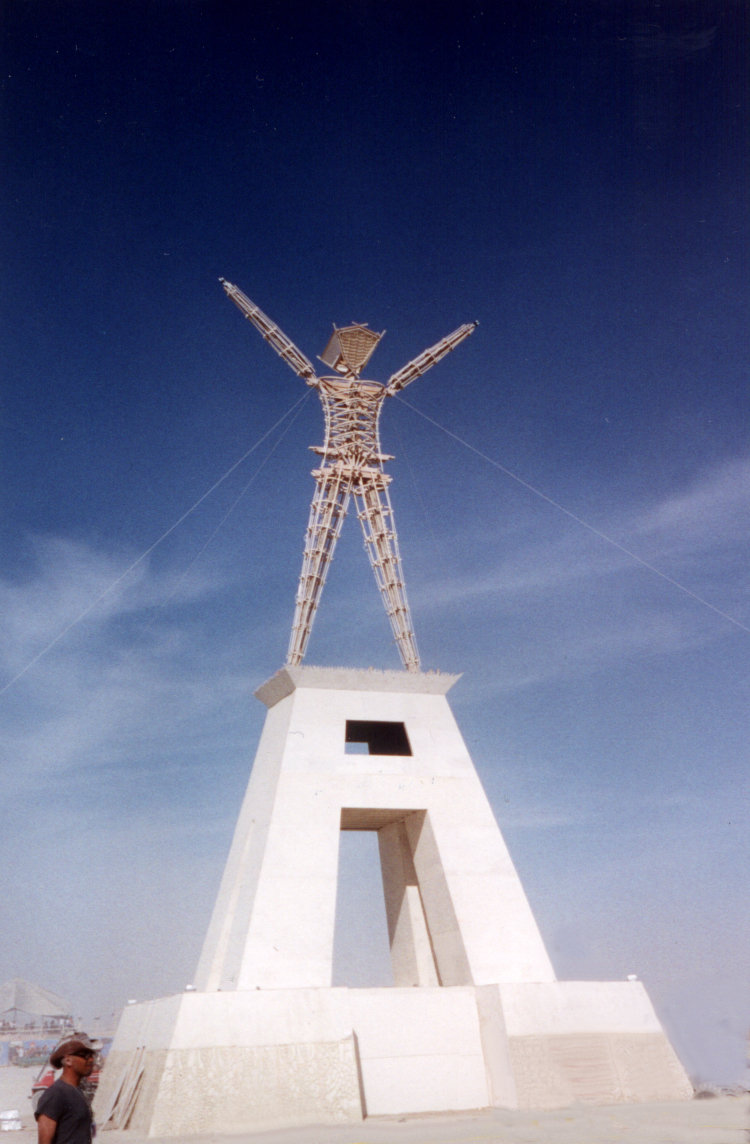
From Wikipedia: Burning Man is a week-long large-scale desert event focused on “community, art, self-expression, and self-reliance”. The event’s name comes from its ceremony on the second to last night of the event: the symbolic burning of a large wooden effigy, referred to as the Man, the Saturday evening before Labor Day.
The event takes place in the middle of Black Rock Lake, 300,000 acres of lakebed that is a dry remnant of Pleistocene Lake Lahontan in northwestern Nevada about 100 miles north of Reno. During the event, the Black Rock Desert becomes Black Rock City, a temporary city erected in the Black Rock Desert and comprised of, at it’s peak, over 78,000 participants, who refer to themselves as “Burners”.
According to Burning Man co-founder Larry Harvey in 2004, the event is guided by ten stated principles: radical inclusion, gifting, decommodification, radical self-reliance, radical self-expression, communal effort, civic responsibility, leaving no trace, participation, and immediacy.
Burning Man features no headliners or scheduled performers; participants create all the art, activities, and events. Artwork includes experimental and interactive sculptures, buildings, performances, and art cars, among other media. These contributions are inspired by a theme chosen annually by the Burning Man Project.
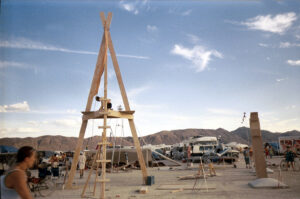
My friend was in advertising, as were several other camp members. The core members had been attending Burning Man since the mid-nineties. They called themselves, “Camp Homeslice”. The ‘Slicers were relatively subdued compared to other camps I would join in later years. They were well organized and that year, they planned to create their first large scale interactive art, a climbable “A” shaped tower. I assisted in the creation of the tower and worked pre-Burn fundraising event. I felt that I was ready for my first Burn.
I was not.
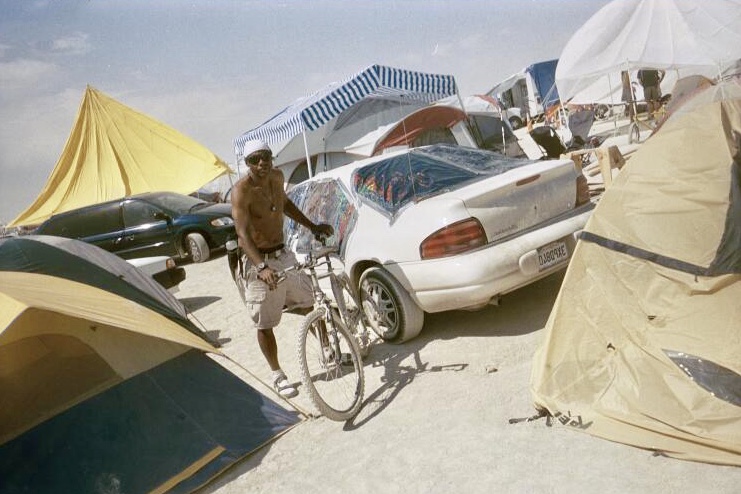
I didn’t have a tent, so I decided to sleep in my car. Or, at least, it was a car when I went to sleep. When I woke up, it was an oven. One of my campmates loaned me a small two-person tent to sleep in, moving all my stuff into the car for storage. The tent was not quite as hot, but everything inside was covered in “playa dust”, the finely-grained alkaline remnants of the ancient lake bed.
It is an extremely harsh environment. Blinding dust storms, extreme heat. If it rains, the ground turns into thick mud which sticks on your shoes when you try to walk on it.
No cars are allowed to drive on the playa. Once you park your car, you have to leave it there all week, so everyone gets around on bicycles. I was foolish enough to bring $1000 titanium mountain bike. It was stolen on the second day. I wasn’t a happy camper.
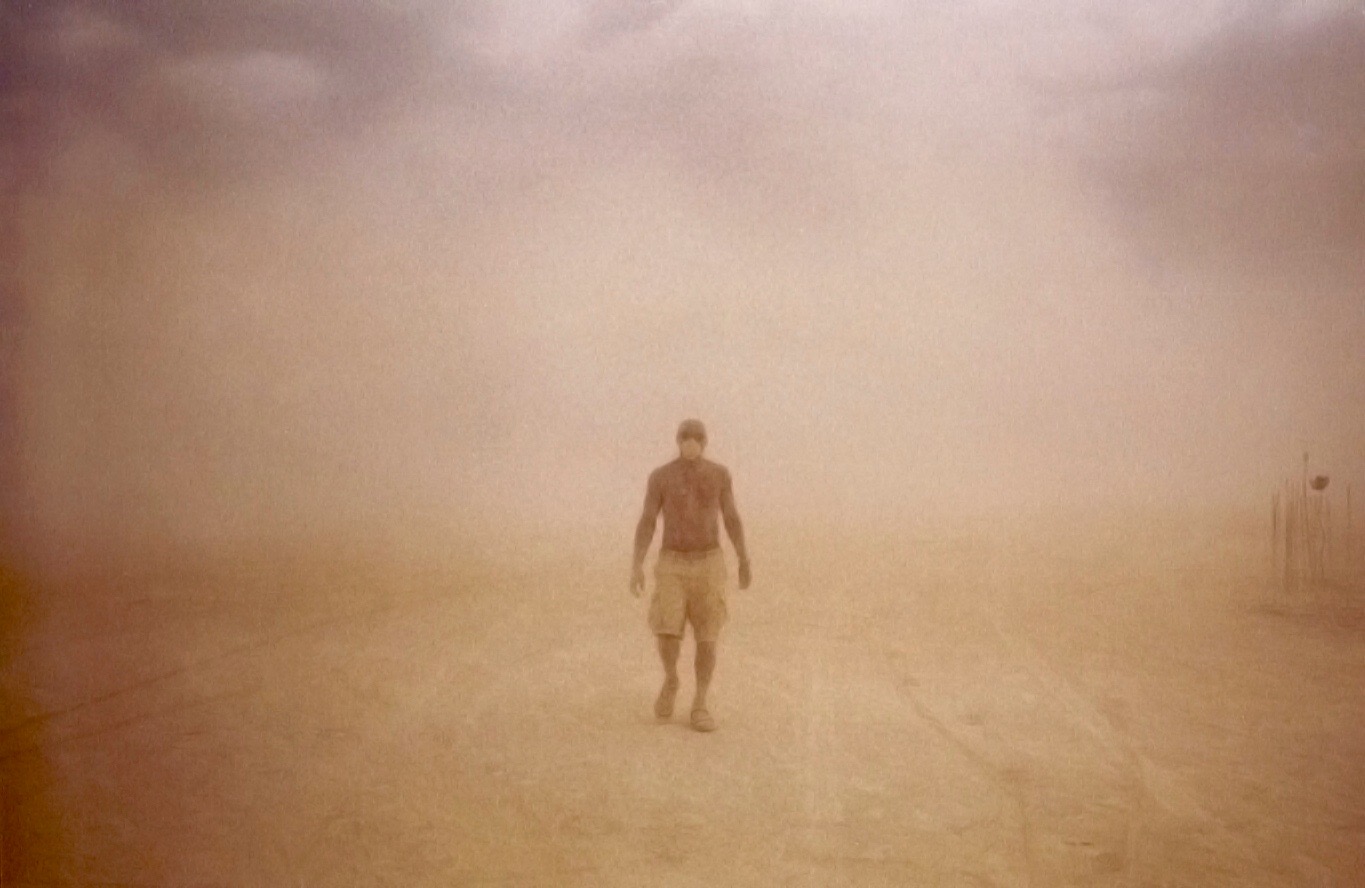
On the third day, I was thinking about going home early. I decided to take one last walkabout to see if it was worth sticking it out. A huge dust storm came up. I couldn’t see more than a few feet ahead of me. I heard a sound of pieces of metal being hit with other pieces of metal. I headed toward the sound and saw a roughly-hewn cart with pots, pans, hubcaps and other stuff hanging from it. The carts was surrounded by people banging out beats on the stuff with drums sticks in the blinding dust. I joined them and, for a moment, time stood still. There was only the sound, the rhythm, the dust and other human beings sharing the present moment. In that moment ,I realized why I was having such a crappy time at Burning Man. I had had my heart set on experiencing this with Krista. I had come to Burning Man to find another “Krista”.
Instead, I found myself.
When I returned from Burning Man to the real world (or the “default world” as Burners put it), I went back to work MarketSource/Fry’s Electronics. I lived in Los Angeles, which meant a lot of driving to cover all of Fry’s southern California stores, including one two-hour drive to San Diego. I can’t say for sure that it was because of Burning Man, but I started thinking about life, about spirituality. I started listening to audiobooks on the long drive between stores, but nothing really resonated with me.
In 1999, Apple decided to end it’s contract with MarketSource and I was out of a job. I wasn’t worried though. I had a lot of experience with Apple computers and dealing with customers. I landed a sales job at Creative Computers, a respected Apple reseller in Santa Monica. They wanted to make a model where I would do workshops and training and would make a commission on every costomer in attendance, but it didn’t work. Why would someone come to our store with they could go an Apple store and get training for free? We then learned that Apple was going to open another store about a mile away. The writing was on the wall. However, there was one week at the store that I will always remember. The Apple rep said that Apple was going to come out with a new product and that he was going to give me one for the week before so that I could learn how it worked. So, for that week, I was one of the few people in the world with an iPod.
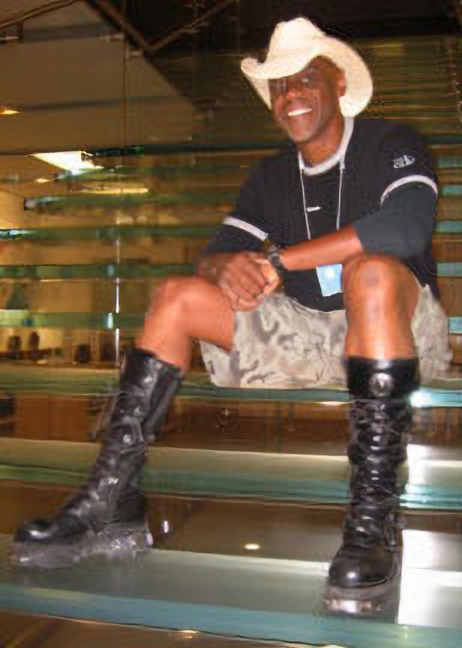
I decided to go to the source. In 2004, I applied for and got a job as a Mac Genius for a new store that Apple was opening in Century city. However, the Century City mall was undergoing renovations, which kept the Apple Store from opening so, our staff was sent to the Apple Store, The Grove, the flagship Apple Store in Los Angeles. It is here that I got to stand behind the bar and have the opportunity to say to some really famous people, “I’m sorry, but you’ll have to wait.”
It was around this time that I started to let my Burner flag fly in public. Apple didn’t care what I wore, as long as I had my Mac Genius shirt on. As Steve Jobs might have put it, I was one of “the crazy ones.”
But, being behind the Genius Bar, I felt like I was in my element, almost like Fred in his barber shop. I also enjoyed being backstage in the service area. I’d get to set and concentrate one just one thing at a time without any customers around. I had all of the tools, parts and information needed to fix any Mac. The experience of being a Genius would serve me well for years.
In 2004, I returned to Burning Man, again camping with Homeslice. One day, I was out and about, but woefully low on water. I stumbled into an unknown camp and asked of anyone could spare any water. That’s when I met Juanita, a bubbly, petite Hispanic woman. We hit it off right away and spent much of the rest of the week together. She lived in Los Angeles and she said that she needed a ride back. We hit it off and started dating afterwards. However, it became clear that a long-time relationship was not in the cards for us and we broke up. We stayed friends, though and, to this day, she is my best friend
In 2005, Juanita and I returned to the Playa together. I had agreed to drive the truck full of all of our camp huge tent shelter and a brand new tower that we all helped to build. It was a challenging, 550 mile drive. When we arrived, strong winds developed, creating white-out conditions. Many shade structures had been destroyed. There was a disagreement between camp management and me about where Juanita and I where we would be placed, resulting with us not having any shade for our tent. A really tough year. I was pissed. I felt like I was not being recognized for effort of bring the camp to the playa.
In retrospect, I get it. There was adverse weather, combined with mis-communications and expectations not being met. But, I decided that I didn’t want to camp with them again. Later, I would start to see my own contributions to the conflict.
In 2008, I created and performed a one-man show about Burning Man, entitled “Burner: Tales from the Playa”. In the show, I told the 2005 Homeslice story. Many Slicers were in the audience. I owned up to my words and actions in 2005 and apologized.
As it turned out, 2005 would not be the last time I camped with HomeSlice.
I found myself becoming more involved with the Burning Man community in Los Angeles. The HomeSlice peeps didn’t seem to do the party scene very much, so I just started going to events on my own and meeting people. Somehow, I got invited to a Burner party at a house in the hills above Studio City. It was pretty good crazy, music, costumes and a pool. One guy looked very familiar. It turns out that we had met each other when I was doing stand-up at a club in Minnesota. He told me that it was his house. He introduced me to many of his friends there, friends who would be my 2007 Burning Man campmates; The Red Light District.
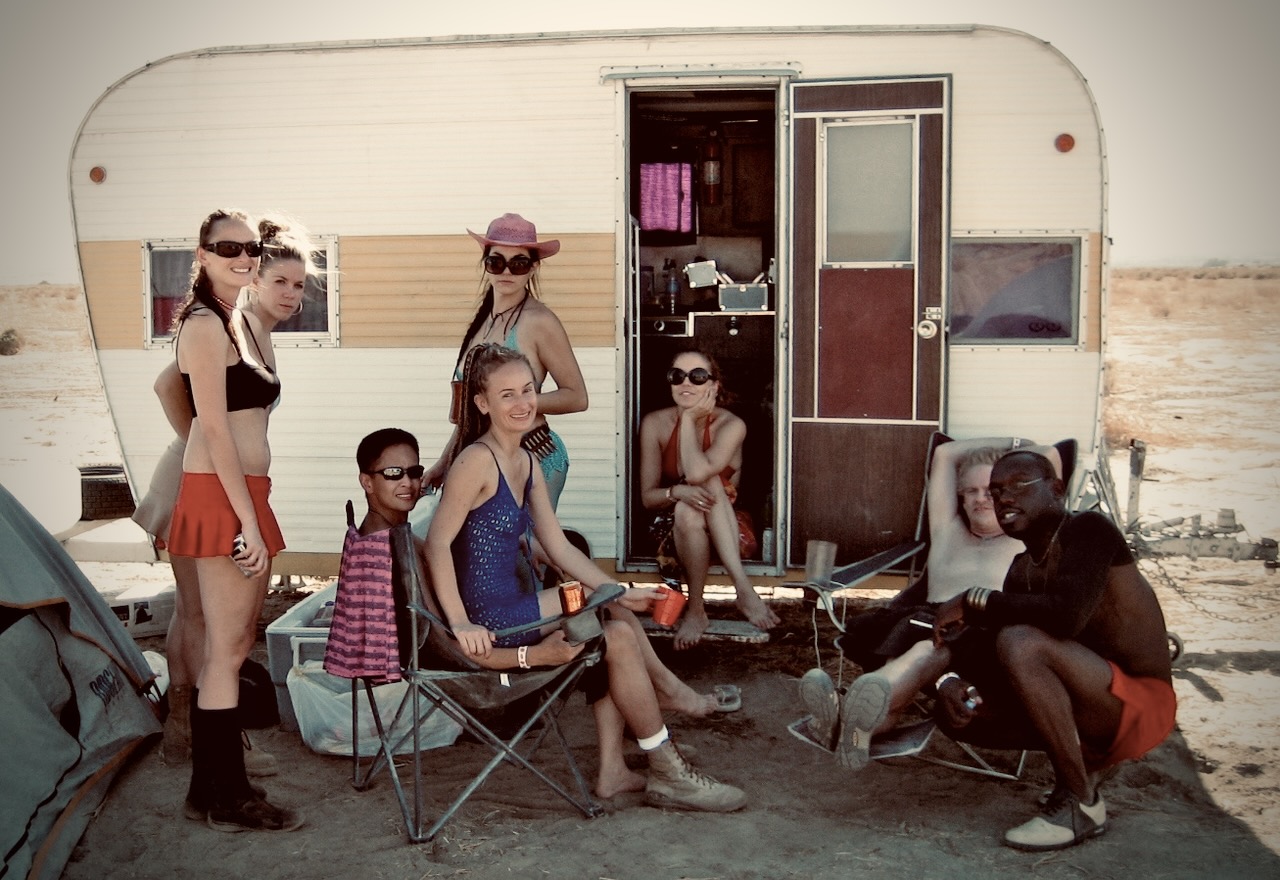
The RLD’s slogan was “Bringing sexy back to the Playa”. They were people from all walks of life, with quite a few from the entertainment industry. The members were varied in age, from 20’s to 50’s. They were a fun and tightly knit group. We would pack up our shade structures, dj gear, party favors and sexy underwear and throw our own events in the Southern Californian deserts and sometimes, even Mexico.
Burning Man 2007. We were dancing to one of our DJ’s and feeling the feels as most everyone had dropped some kind of trippy shit. A younger guy invited four or five of fellow campers to see a small dome they had build. His girlfriend asked me to come along. When I got inside the dome, there were all ready a few people having sex. But, I was only a couple of steps in when the boyfriend came up to me and said “No. You have to leave. “No, I invited him.”, the girlfriend said. The bf was adamant. “I don’t care. You have to go. Leave!” The gf looked at me, embarrassed. “Sorry.”
Was it because I was Black? Old? Both? The boyfriend, up until then, had always been friendly to me and we hung out often. In any case, my feelings for the RLD changed in that moment. It reminded me that Burning Man was no different that than “default world”. You just never know what people be thinkin’.
But my last year with the Red Light District proved to one of the most crucial for me for two reasons.
When I compare my photographs in 2005 to 2006, there is a huge difference in quality. In 2005, I started not only attending Burning Man events. but photographing them as well. There were so many parties and events, I started to really get some idea what I was doing behind the camera. I became an event photographer. My subjects were the people of the LA Burner community and, later, the Southern California festival scene. I was no longer a just participant, I was a contributor. And I’m so grateful to have been able to photograph the amazing art and people of Burning Man.
The second reason: In 2006, I was dancing in an art structure called the Belgian waffle. There I met Maria, a lovely woman from Portugal. I met up with her after the burn and we dated for a short time until she eventually had to return to Europe. I have stayed friends with Maria this whole time,
Meeting Maria was an inflection point for me, for it was Maria who told me about “The Power of Now”.
When I returned from the Playa I realized that it was time for a change. Working as a Mac Genius for Apple was great and all, but something was missing. It’s not like I really wanted to move up at Apple. After all, no matter how amazing their products were, at the end of the day, it was still just retail. I missed having a creative outlet. I had great ideas but I knew I couldn’t pursue them as long as I worked for Apple. So, I left.
I made it so I could still do my favorite Genius things, helping customers and fixing Macs, but to do them for myself. I started my own business: “‘I’m Your Genius’ Personal Mac Support”. In addition to the Mac support business, I got to persue an idea I had while working at Apple, but could not possible do it while I was working for them.
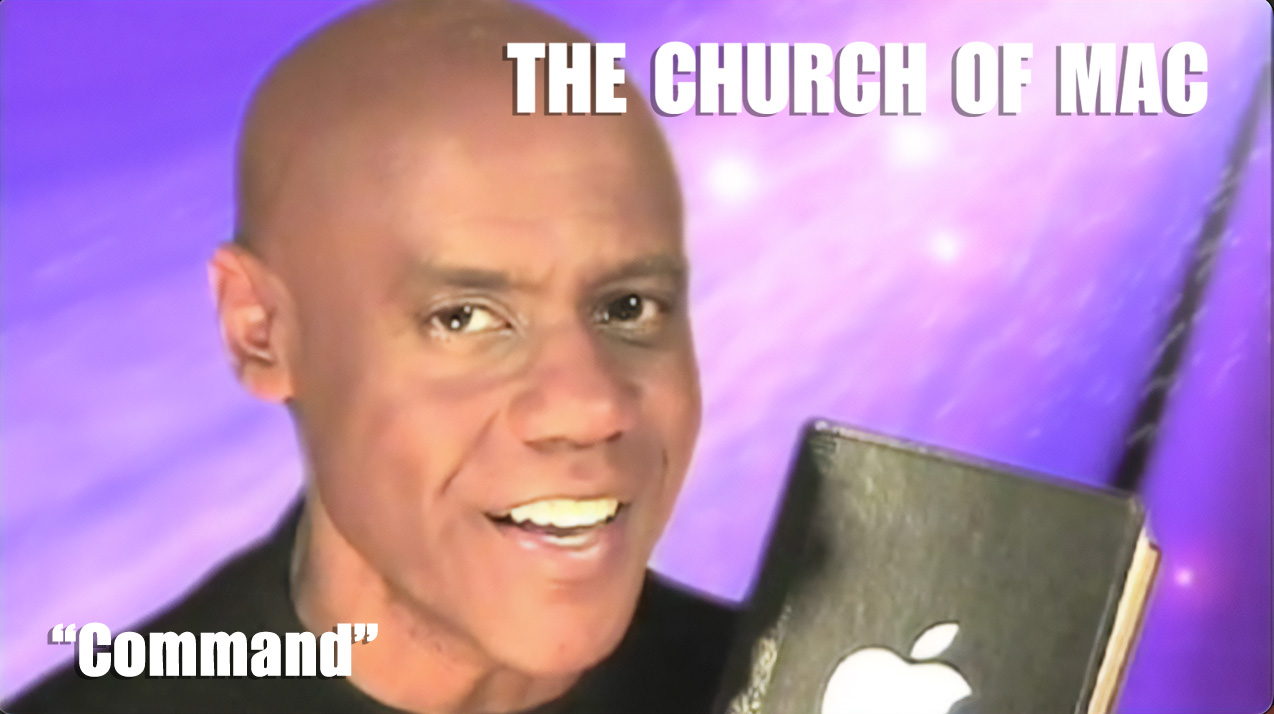
Between Marketsource and Apple, I had the equipment and the knowledge everything to make videos. I wanted to play off of the sometimes near religious fervor for Apple products. I created a series of videos (in 1996!), “The Church of Mac”, featuring a character named the Reverend Dr. Bobby Newton. In the videos, Dr. Bobby would read letters from his “followers in Steve”. I wanted the videos to not only be funny, but also to give some useful Mac information. I even made a video where Dr. Bobby shilled for “I’m Your Genius Personal Mac Support”. Made me smile, at least.
When Steve Jobs fell ill, I ended “The Church of Mac”. But, it’s still on YouTube if you want to check it out.
2007
I was still doing my I’m Your Genius stuff. But instead of driving all over Southern California, I found myself serving clients who were more in my general area. Most were everyday people, but there were some clients who were pretty famous, such as Cheryl Crow and Stevie Wonder. A friend of mine was a low-voltage electrician who had a client that needed Mac help, so my friend suggested me. The client turned out to be Leonard Nimoy. It was funny because he had hired me years ago to play a brief part as a helecopter pilot in “Star Trek IV: The Voyage Home”. I got to his house and he remembered me. We chatted for a bit, then sat down to figure out what was going on with his iPad and iPhone. As I sat at his desk, I noticed a small lucite cube with something in it. I couldn’t help but pick it up for a closer look. They were latex ear tips. Mr. Spock’s ear tips. So cool.
I still found myself driving long distances, though. My mother and stepfather, Wayman, had decided to move out of the Valley to Las Vegas. I found myself taking that long drive several times a year. And, when I did, I took the opportunity to listen to “The Power of Now” again and again, each time the teachings resonating more strongly.
The thing that struck me then and that stays with me today was that, what Eckhart Tolle was saying…just made sense. It is, for the most part, logical. There was very little faith required to understand the main principals that Tolle was espousing.
Thoughts are not “real”. You cannot see, hear, touch, taste or smell a thought. Okay, I’ll buy that.
Past and future are not real because they are thoughts.
Consequently, the present moment is the only thing that is real. You know this, too. You know that it is real because you are experiencing it right now. You don’t need anyone to tell you that, because you are aware of this moment. You are aware of everything your body can sense and you are also aware of your thoughts.
As well as I can know anything, I know that I am, at my essence, conscious awareness. I am awareness that has become aware of itself. A human, being.
This is my absolute truth, but it is mine alone. I can’t “prove” this to anyone else. I had to rely on my own logic. So, I asked myself, “Does this work?”
When I started studying The Power of Now, my life was in fairly normal. There were no serious life challenges. But, I remembered this quote from the book; “The best indicator of your level of consciousness is how you deal with life’s challenges when they come.” I started becoming aware of challenges, no matter the size, looking at them as experiments in consciousness.
At first, the challenges were relatively innocuous, such as the neighborhood dogs that would just not stop barking. After trying, to no avail, to get the owners to do something about the dogs, I decided to stop having resistance to the barking. I got into the habit of listening to the barking without getting angry about it. Then, I surprised myself when one day, I realized that not only were the dogs not barking, I couldn’t remember the last time they barked.
Like stair steps, the size of the challenges grew with the level of my presence. And every time I applied what I had learned, then I looked at the outcome, I would find myself saying, “That turned out well.” It worked.
Still, there was something in the book that I had not experienced. Something esoteric and not at all logical.
One night, I was at a party in Downtown Los Angeles. Many of my friends were there and the small venue was crowded and loud. I decided to step outside for some air. I looked up into the night sky and felt the cool air on my skin. I closed my eyes and took a deep breath.
Then, I felt something in my body. A wave of energy started in my belly, then rose up to my head. My eyes welled with tears. I felt…joy. I was happy, but confused as well. “Where did that come from? What was I thinking about?” I realized that I wasn’t thinking about anything. I wasn’t…thinking.
I had experienced what Tolle calls, “The Joy of Being”. This experience, which in the Zen Buddhist tradition, is called “satori” or “kenshō”, is a moment of intense felt oneness with being. It arises when there is a discontinuity in the mental stream, a gap of “no mind”.
I had experiences this before. But, the thing is, we all do. We feel it when we jump out of an airplane, ride a roller coaster, or…when you find yourself standing in a blinding dust storm banging out beats on pots and pans. Any activity which takes us, if only for a moment, beyond thought. However, for the first time, I experienced it clearly, without the cloud of thought or the distraction of activity obscuring it. I felt my own joy of Being. It was my first awakening.
2007
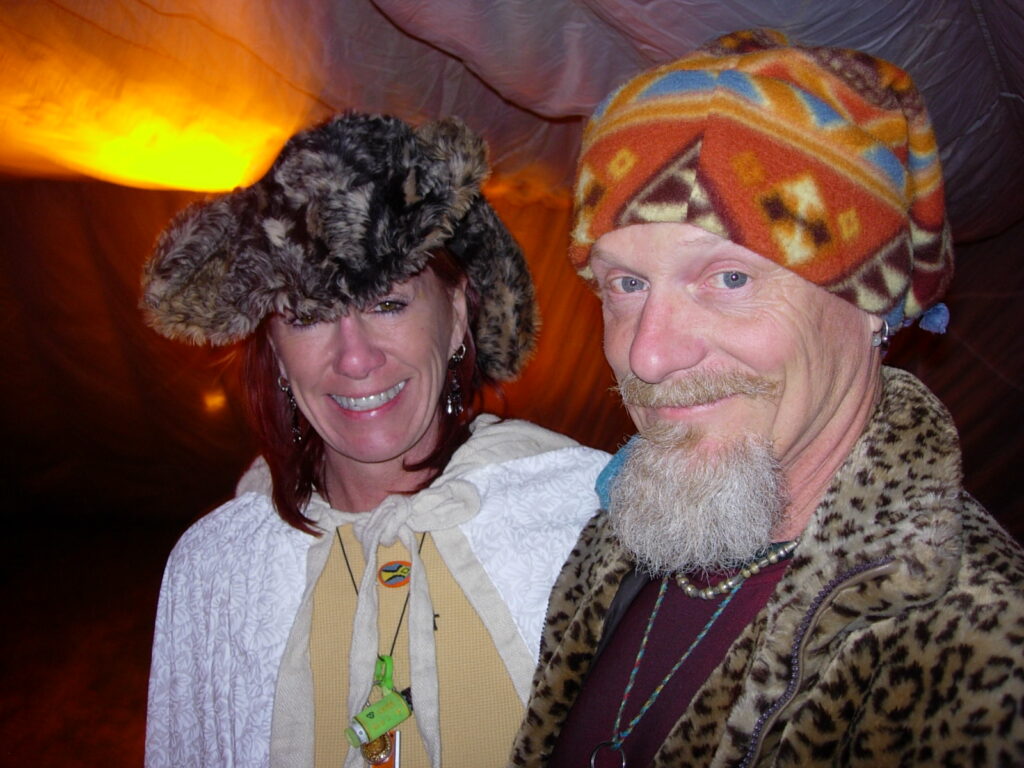
I didn’t have a camp to go to the Burn with. But, in my travels to various underground Burner parties, I always seemed to run into these two friendly folks, Johnny and Mo. They were always upbeat and kind. One night, we were talking about Burning Man and they invited me to meet their campmates. They called themselves the “Broken Staples”…
Okay, one time on the playa, they brought an old sofa that they had somehow four wheels on that could be pulled from an art car. But, somewhere along the way, one of the heavy duty staples they used broke. They had to carry that side of the sofa as it went. People would come along and ask, “What happened?” “Broken staple.” they replied…over and over again.
The Staples split the difference between Homeslice and the Red Light District. They were ready to party all night, but were completely cool and kind, not only to each other, but to most everyone they met. Really more like a family than a bunch of Burners. They were also quite industrious and had years of experience on the Playa. They asked me to join them at the Burn and I said yes. They had a genuine family feel, they cared for each other. I love them still.
Our burn that year came off without a hitch. One day, I was out in front of our camp, practicing spinning my fire staff. I noticed a woman across the dusty street. She seemed like she was watching me.
Finally, I got up the courage to walk over to her. “Hi.” I said. “Thank God! I was wondering how long it was going to take you to come over here. I thought you might be gay.”
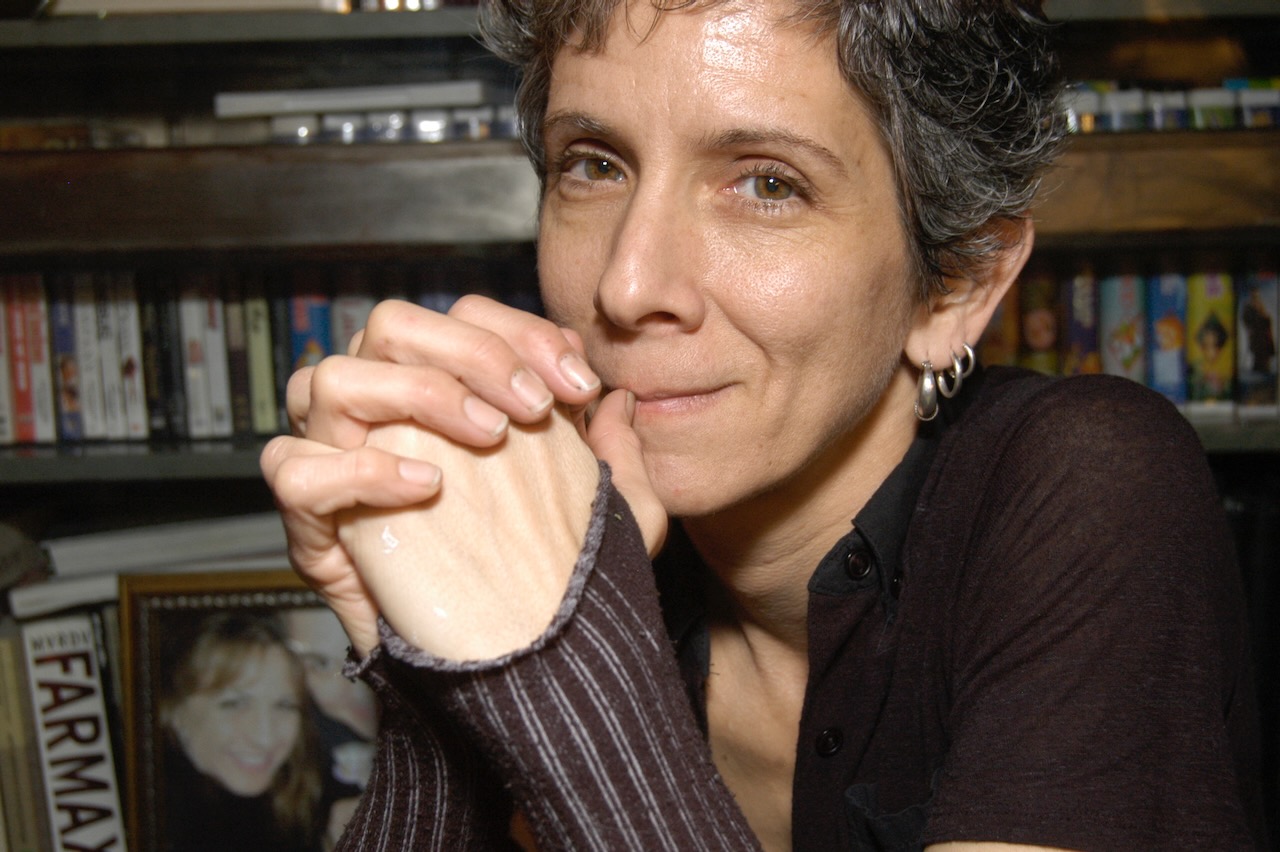
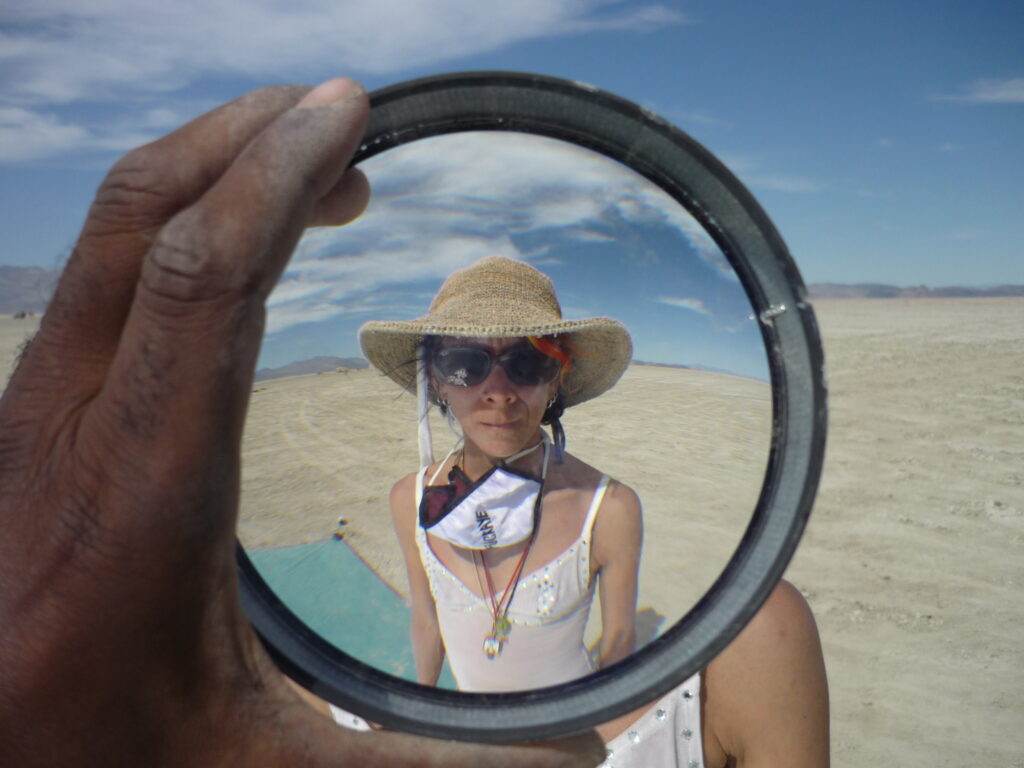
Her name was Laura Diamond, and her “Playa name” was “Diamond Cutter.”
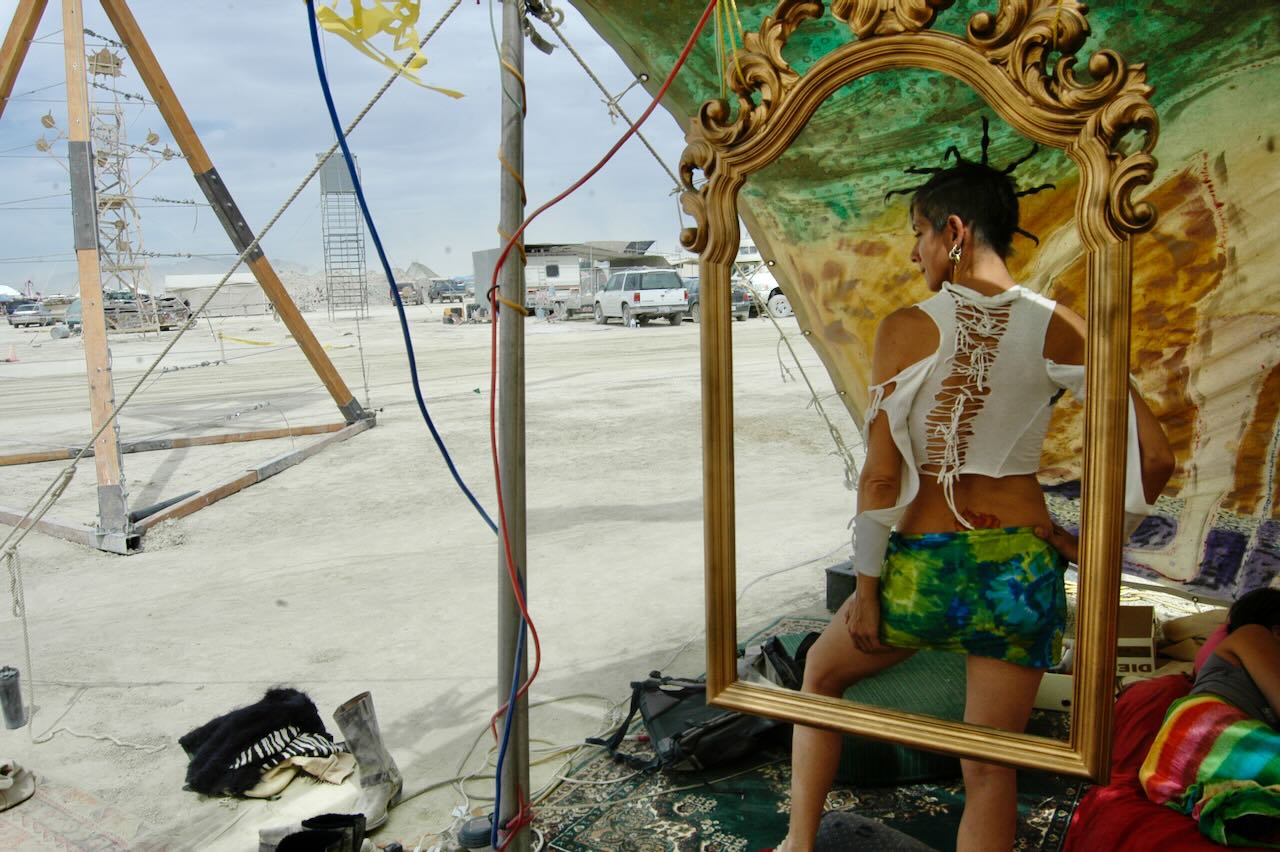
Chapter Four | Laura
laura
divorced with kids
art department
the first episode
pick a choice
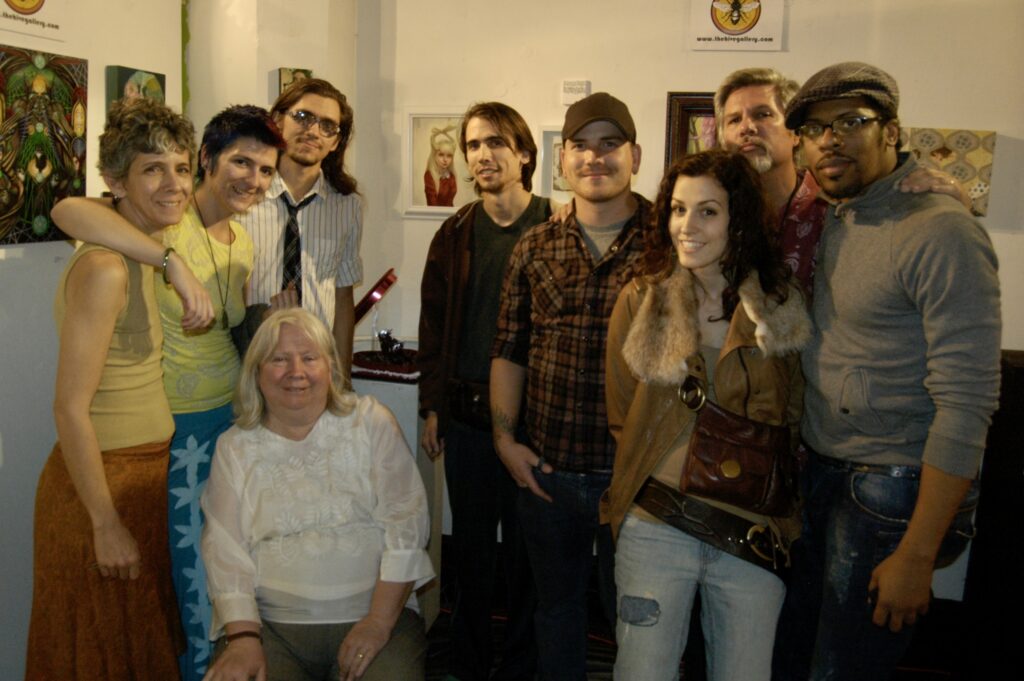
Later, Laura learned that she had to leave the small house in which she lived. She had a friend who worked with her in the art/prop making business. Her friend lived in Downtown Los Angeles in an artist colony called The Hive. A small living space had opened up and Laura moved in. She now had not only a place to live, but also but a studio where she could create her art. Consequently, I made many trips downtown to see her. The Hive was where Laura really came into her own, creating painting and sculptures and having her work displayed at The Hive Gallery. She thrived there and made many new friends.
Meanwhile, I was still doing personal Mac support, going on auditions and photographing my friends at Burning Man events. Although I became pretty good at it, I almost never got paid. Instead, I was gifted with something even greater. For the first time in my life, there was something other than show business or computers that I knew was really good at (thanks again, Mrs Olsen)..
It was all because of Burning Man. I loved walking around and photographing the art on the Playa. And, when I wasn’t at the event, I found the same joy shooting local BM parties, campouts and shows. Many of the people I met and still friends today, even though I’m thousands of miles away.
2009
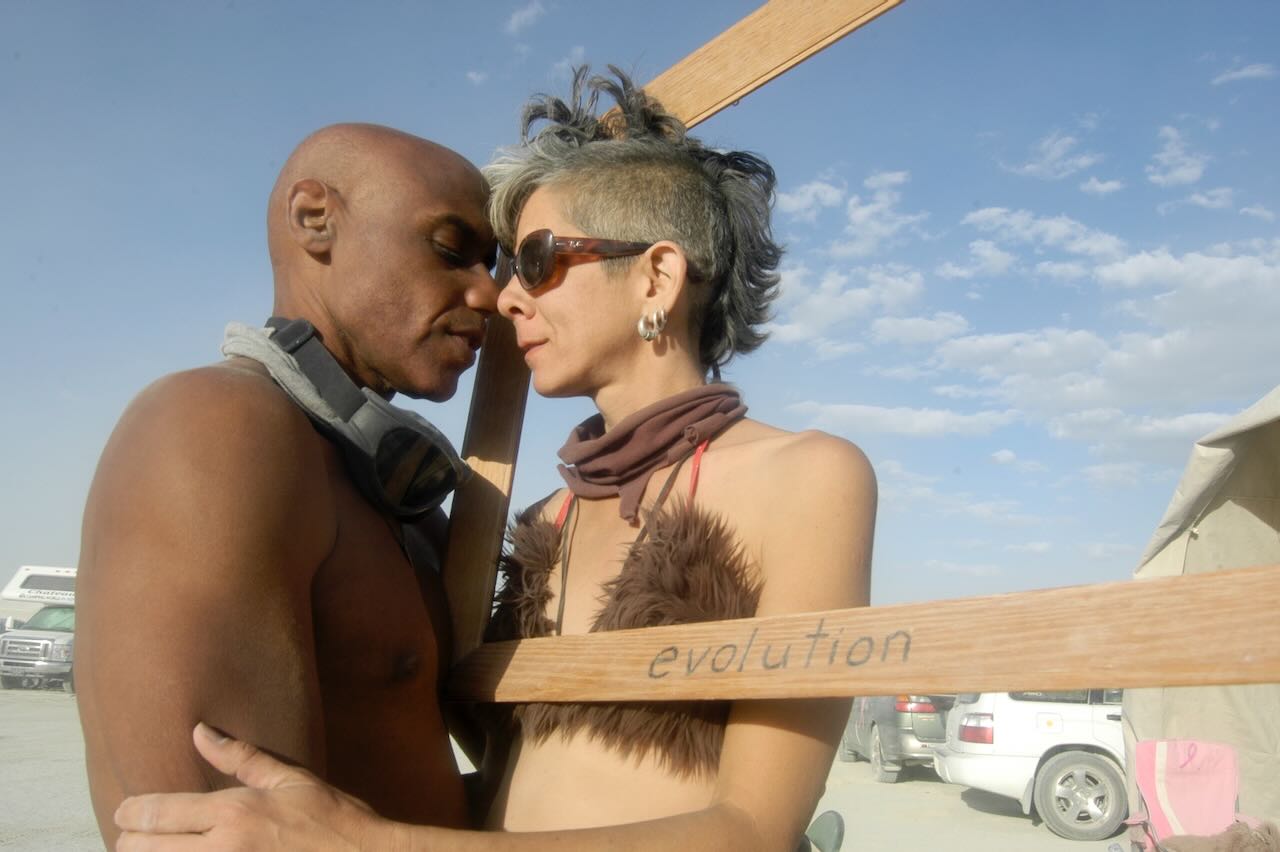
Having made my peace with them, Laura and I camped with Homeslice, who welcomed Laura with open arms. I was a very good year for us. We had learned about each other, respected each other and were in love with each other. We also recognized that we knew what we wanted.
In addition to “The Man”, there is another structure that is built, then burned at Burning Man. It is called the Temple. It faces the Man and beckons participants to take a respite within its walls from the revels of the event all around it.
Artist David Best first constructed the Temple in 2000 to commemorate the death of a friend who had passed away in a motorcycle accident en route to Burning Man. The next year and the years that followed, the Temple became larger and embraced all of humanity.
The Temple is burned on Sunday night, the last night of Burning Man. As opposed to the rowdy bacchanalia that occurs when the Man is burned, the Temple burn is a much more subdued and introspective experience. That year, Laura’s father, Bob Diamond had died. Laura brought Bob’s remains to be burned at the Temple that Sunday. We also promised that if one of us were to die, the other would take them back to the Temple.
In 2009, it was not unusual for people who had lost loved ones that year to bring their remains to be burned in the Temple. However, it is now longer allowed. Burning Man’s neighbors are the Pyramid Lake Paiute Tribe. As inhabitants and caretakers of this land for centuries, the Paiute believe that leaving non-native human remains on native land adversely affects the living spirits within the Lake and Black Rock Desert. Out of respect to the Paiute people and culture, it is asked that Black Rock City participants refrain from leaving cremated human remains at the Temple.
On Wednesday of that week, we decided to get married, one year from that day, at Burning Man.
And yet, I knew that there was a very good possibility that this wouldn’t last. Laura’s oldest daughter and her grandson lived in Northern California and Laura often talked about moving up there to be closer to her. I was supporting both of us with money from consulting and acting, I felt like I needed to be in Los Angeles to make a living, not only consulting, but acting as well. But I learned that if Laura wanted something (or someone), she was hard to stop. Laura was going to do what she was going to do. Having resistance to that was useless.
As for myself, life mostly consisted of consulting calls, a few auditions, going to Burning Man and photographing electronic music events and partying with friends.
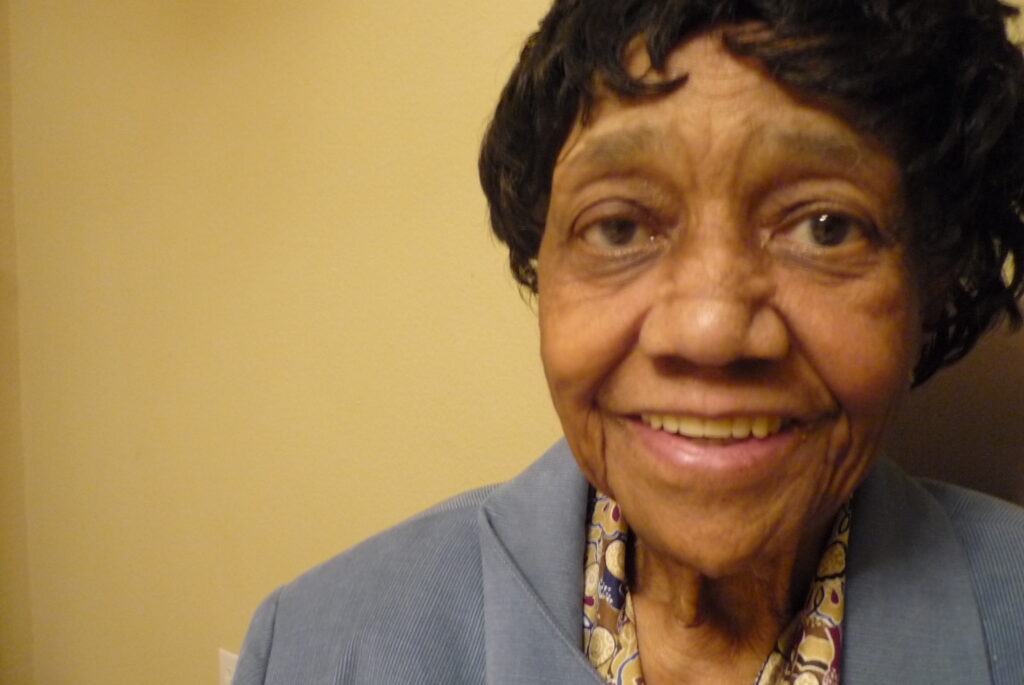
2009 was also the year that my mother, Thelma Louise Westfield died. Laura and I went to the funeral in Las Vegas together. This ended up being on of the largest gatherings of my family I had ever seen. Greg was there with his two grown daughters, my nieces. But I also met Fred’s other children and their children as well.
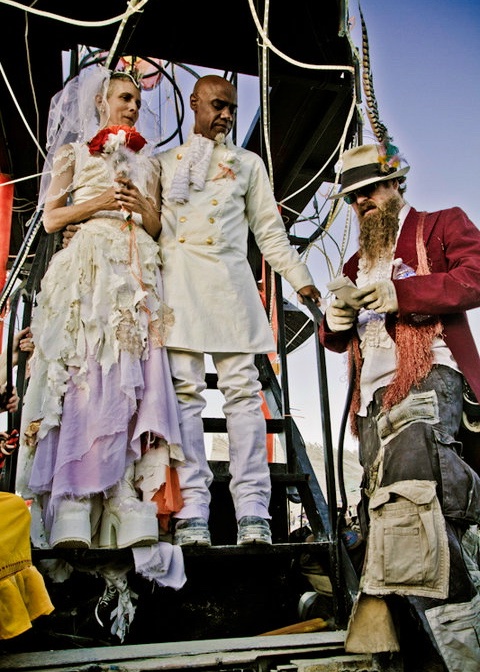
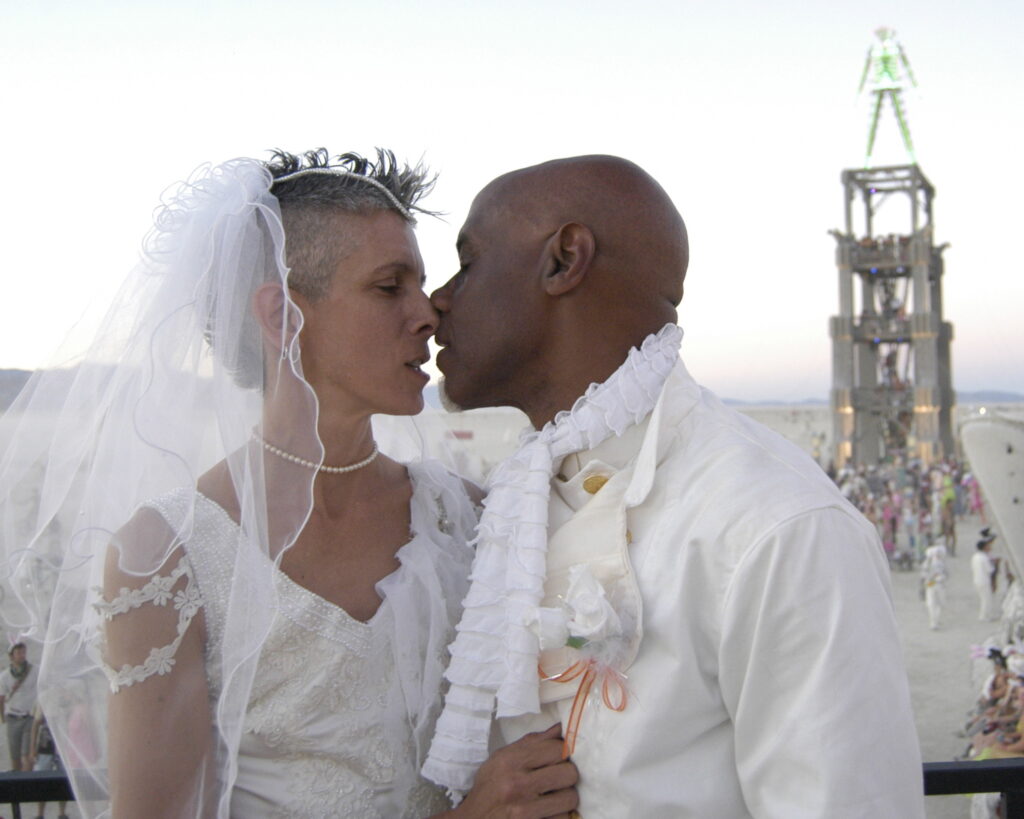
2010
Laura, after spending two years studying at Los Angeles City College, transferred to UCLA, pursuing a Bachelor of Fine Arts degree. We were also planning our wedding. My friend Juanita and her partner were planning to do a small camp that year. When she heard it we were going to get married on the Playa, they kindly offered to host us, including an RV (a super big deal at Burning Man)! Also, it was great because we didn’t have a car at the time.
Laura and I were also working on a friend’s art car project. At Burning Man, you can’t drive your car around the playa. However, an allowance is made for special projects, art cars as they are called. Our friend, Gadget, was a car guy. He started with a 60’s Cadillac Coupe de Ville, and wanted to chop the top off, then build on top, a giant rooster. It was known at the Giant Cock Car. Laura and I both worked on it (she learned to weld!). Our friend offered drive us on the GCC and take us out on the playa for our wedding.
Before we went to the Playa, we stopped in Las Vegas to get legally married. But, it was Vegas, baby! How could we not get married by Elvis?
Three of Laura’s kids came to Burning Man for the wedding (one in a wheelchair!). Friends we had made in our other camps came out. We had planned to drive out to the Temple, a shrine-like structure far out near the outskirts of Black Rock City, and do the ceremony there. When we arrived, I jumped off to check out the scene and, I wasn’t feeling the vibe inside. Too noisy.
I ran back to the GCC and said, “Let’s just do it here.” And, we did.
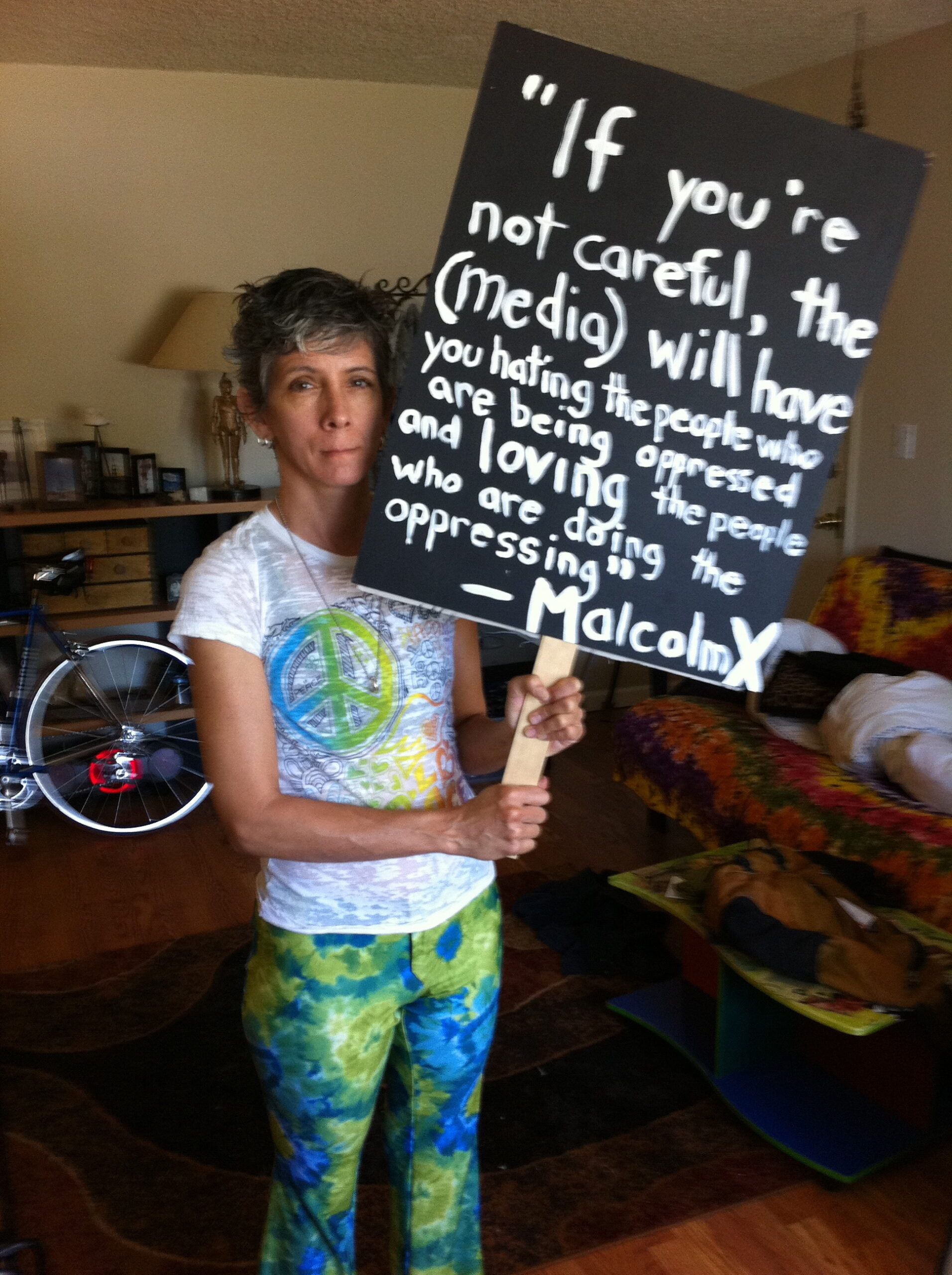
The next five years, life settled into a pattern. Laura and I lived in our tiny, one-bedroom apartment in North Hollywood. We squeaked by, but it was enough. I’d see consulting clients during the day and/or go on auditions. I started to look older and I think that maturation helped my career.
Laura was studying hard at LACC. At night, I would often go out and photograph underground parties, campout events and performances. Sometimes Laura would put her studies aside and come out with me. However, a new part of her personality emerged.
2011
It was the year of “Occupy Wall Street”. Laura, joined the fight and camped out across the street from city hall in Downtown Los Angeles for the Occupy LA protests. She was arrested with many other protesters in an LAPD sweep. When I met her coming out of the jail, she had the biggest smile on her face. It was her birth as a social justice warrior.
2012
I wanted to go to Burning Man, but Laura was too busy with her studies to take that much time off. We agreed that I should go alone.
It was a strange year. I ended up camping with a bunch of people that I didn’t know. Most of them were from Northern California and in the tech industry. Although they were nice enough, I felt like I didn’t have anything in common, with the exception of one person. Their name was Blair, a civil rights attorney. Blair told me that they weren’t feeling the vibe from the other campers either. Blair said that next year, they were going to lead their own camp and that I was welcome to join them.
2013
Laura graduated from Los Angeles City College and planned to transfer to UCLA in the fall. In two years, she would receive her Bachelor of Arts degree.
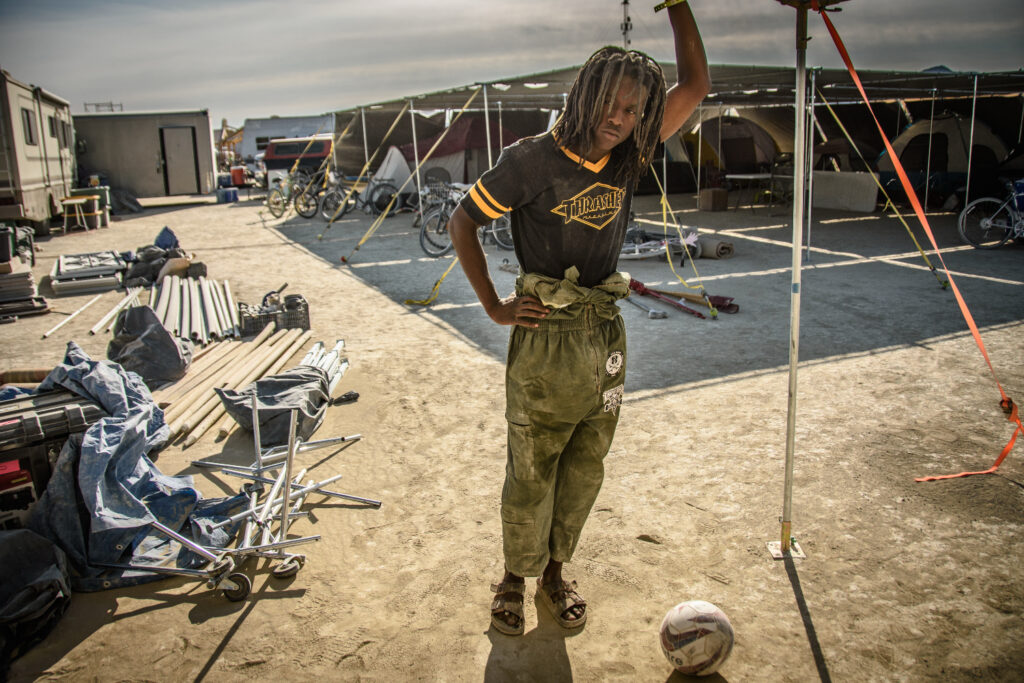
This was also the first year for Blair’s camp, “Que Viva! Camp”. After that year, Blair said the the running of the camp was too big a job for one person. They suggested that next year, there would be mulitple camp leaders. Blair suggested that I lead the camp for the layout, design, percurment and construction of large shade structure capable keep a large number of tents cool(ish) during the day.
This was actually a big thing for me. In my life, I have never been asked to lead a project, so it felt good that someone thought I had it in me. Maybe it was always there and I just didn’t know it.
Laura was also asked to be a camp liason to the Burning Man Organization and chaired meeting with several Board members. Favianna Rodriguez,
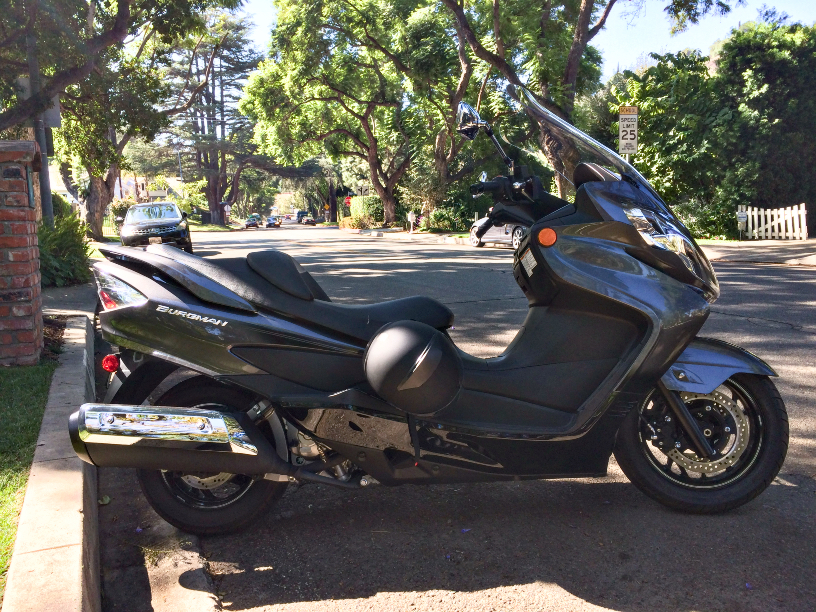
I drove the bike everywhere, through the canyons of the Hollywood Hills, keeping pace with cars on the freeway and parking it just about anywhere.
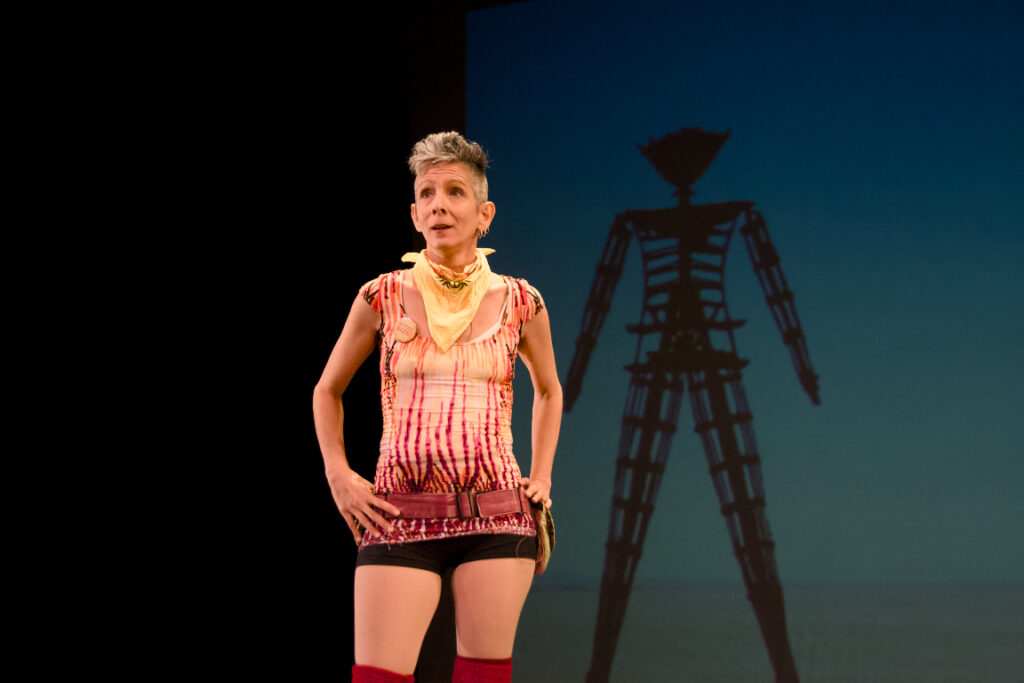
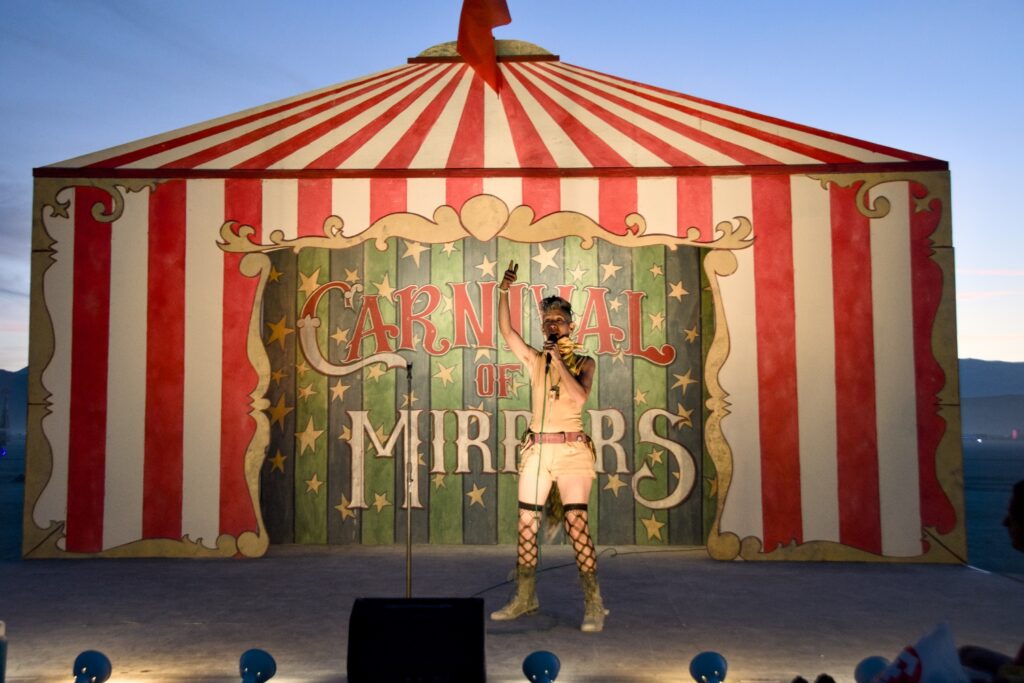
Laura worked very hard at UCLA and her work paid off. In 2014, she had to do a senior project and decided to create and perform a short, one-woman show about Burning Man. As I had already done two one-man shows of my own, she asked me to direct her. I also used what I had learned in my photography, videography and graphics to create the visuals for her show. It was called “Dear Burning Man”. In the show, she addressed a large projection of the Man. The told him of how much she loved him for accepting her and people like her. She scolded him for the encroaching commerciality he seemed to start to embrace. I marveled at what a force of nature she had become.
Center Camp at Burning Man is one of only to places where you can buy anything. They sold (apparently the don’t anymore) mainly coffee, and is the gathering place of Black Rock City. There is a stage where anyone can sign up and perform to whoever is there at the time. However, this year, they moved to open stage to the Man. Laura decided what better place to perform “Dear Burning Man” but before the Man himself. Laura’s step-father came the playa to see the performance as well as her daughter.
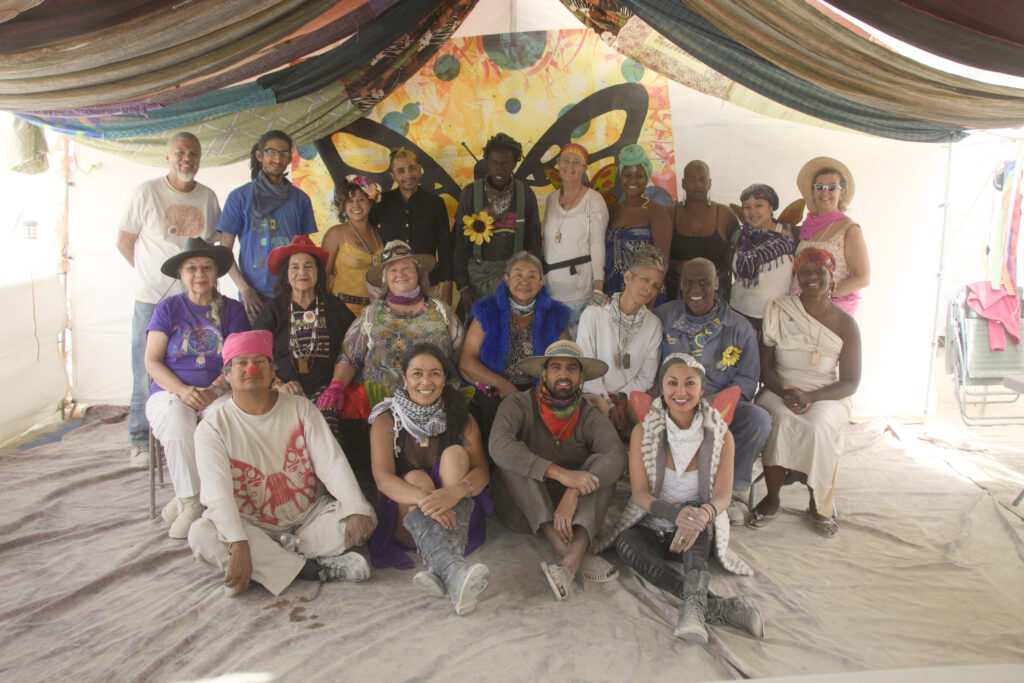
Que Viva! Camp was out in full force. In addition to gift the community with self-painted butterfly wings (because because butterflies migrate freely), they stirred up some of the anti-woke members (and they are there. Just ask Elon.) of BRC with a large “Hands up! Don’t shoot!” banner at the entrance to the Temple.
In addition to performing her show, Laura acted as spokesperson for the camp, giving interviews and leading discussions on Radical Inclusion (one of the 10 principles of Burning Man).
2014 was crowning achievement for Laura. Her best year ever. I was so proud of her.
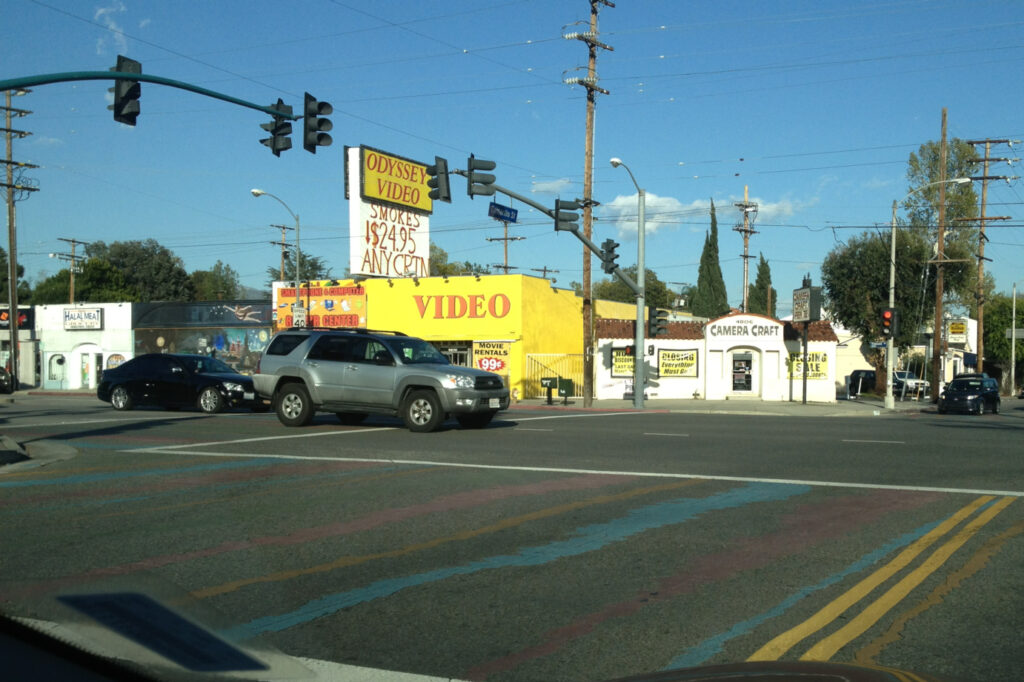
Having returned from Burning Man and weilding her brand new degree from UCLA, Laura set out to find work. On October 7, 2014, Laura and I set out on an errand to get a form she needed to apply for a particular job. The morning traffic was already heavy and we stopped back from a busy intersection.
We were behind a large, cement mixer truck. I noticed that it had a tag axle, extra wheels which help stabilize the rear of a cement truck by distributing its heavy weight more evenly. I knew from experience that if the truck is full, this axle will lower to the ground once the truck starts moving.
But I figured that Laura probably didn’t know that and I did want her to panic, traffic was still not moving, so I slowly filtered up on the right side of the truck. There wasn’t enough room to get past it, but we had space on either side.
The signal changed and traffic started to slowly move. I moved with it at, maybe, 2 mph. I heard Laura say, “Tony, look out! The truck!” I glanced back in my left mirror and caught a glimpse of Laura reaching out toward the fender of the truck. I looked forward again and then, in a split-second, the world looked like video from a falling GoPro camera. Then, nothing.
When I came to, I was surrounded by people tell me to not move. I must have been in shock because I don’t remember being in pain. I looked down at my left foot. It was rotated 90º past where it should have been. I asked, “Where’s Laura?” They tried to not let me see her, but I did. I dragged myself over to her. When I asked what happened, some brave soul told me; she had been run over by the truck. I held her as she took her final breaths.
An ambulance arrived. They took me not to one of the local hospital, but to a hospital near Beverly Hills, Cedar-Sinai Medical Center. Cedars, as it is known in LA, is the hospital where famous people go when they get sick. I didn’t care. I was in shock. All I could think was “What happened? What did I do wrong?”. At the hospital, they straightened out my foot and applied an external fixator (click for pic at your own discretion). After staying overnight, they sent me home.
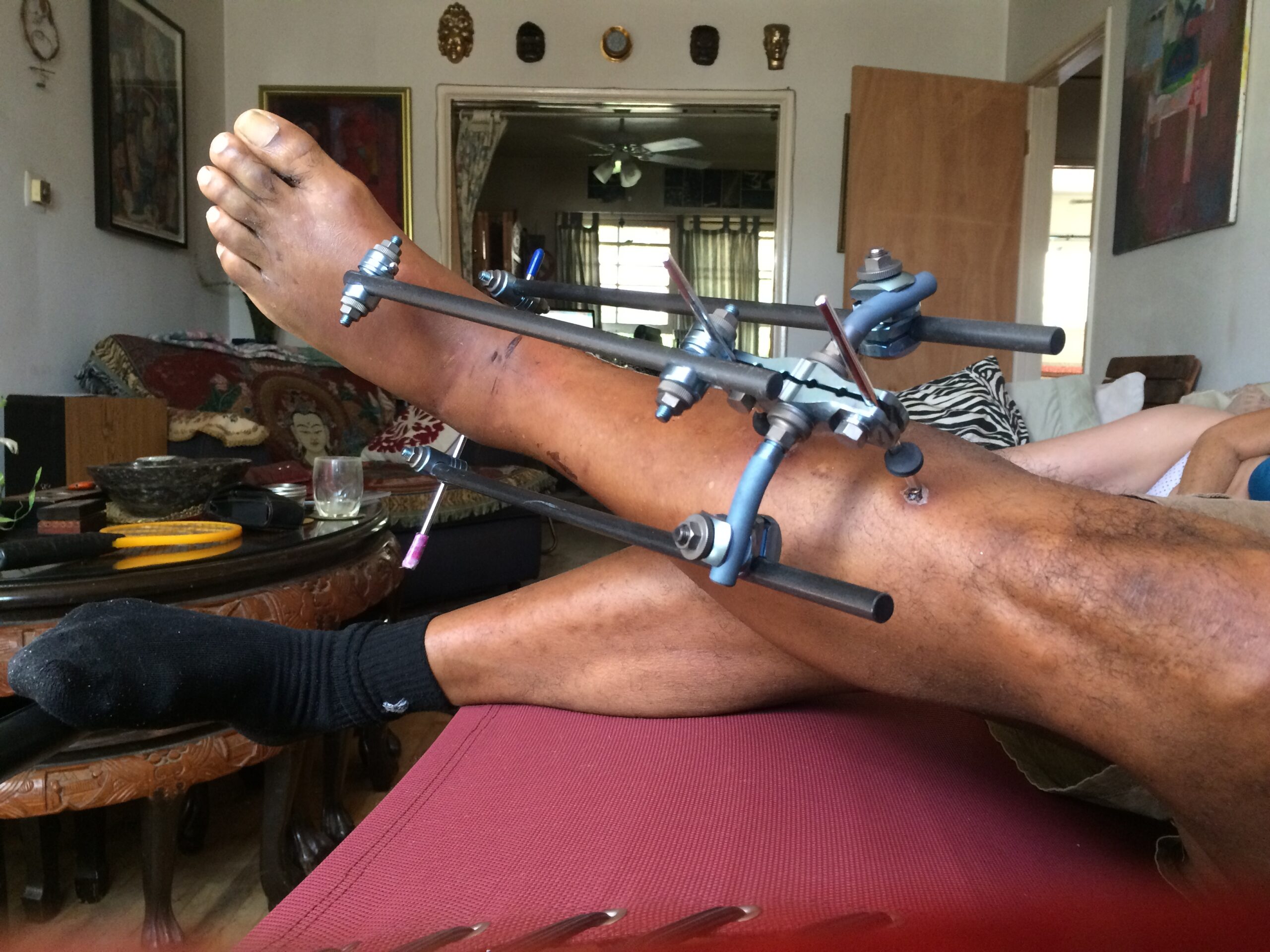
But what home? Our little apartment in North Hollywood? Nevermind that it would have been incredibly sad to stay there without Laura. It was on the second floor; I wouldn’t be able to make it up the stairs on crutches and with my Franken-foot.
Fortunately, I had friends. One of Laura’s and my closest friends, was a woman also named Laura. But all of her Burner friends called her “Hippie Chick” or just “HC”. Hippie Chick graciously allowed me to stay in a spare bedroom in her small house in Burbank tucked up right underneath the interstate five freeway. It was there that I recovered from my injury. HC and other friends changed my bandages, took me around on errands and out to eat.
But, to be sure, there were challenges ahead. My driver’s license was suspended and the accident investigated by the LAPD. A Burner lawyer friend suggested an accident lawyer to help me with the case. He talked to witnesses to the accident, as did investigators from LAPD.
I had just had a surgical treatment done at one of the most prestigious hospitals in Los Angeles but I had no health insurance. Soon those bills would arrive. What then?
One of the greatest things about our relationship was that Laura also followed the teachings of The Power of Now and practiced them in her everyday life. During the time that we were together, I could see her presence growing day by day.
But now, she was gone. As my leg healed, I spent many hours in the backyard of Hippie Chick’s house. “Why did Laura die?” asked myself over and over. It didn’t take long to realize that I was once again presented with a challenge. And again, Eckhart Tolle’s words echoed in my mind.
“The best indicator of your level of consciousness is how you deal with life’s challenges when they come.”
There was really only one choice. I couldn’t leave the situation or try to change what had already happened. I knew that I had to accept the situation fully and without resistance to it. The old couch on the patio of HC’s house became my place of reflection. I would sit for hours, watching the leaves on the tree and listening as the wind blew through them. I listened to the sound of the leaves as well as the sound of cars and trucks on the nearby freeway.
It wasn’t long before an answer came to me. An answer distilled from all of the facts, questions and guilt into a simple truth.
“There was an accident.”
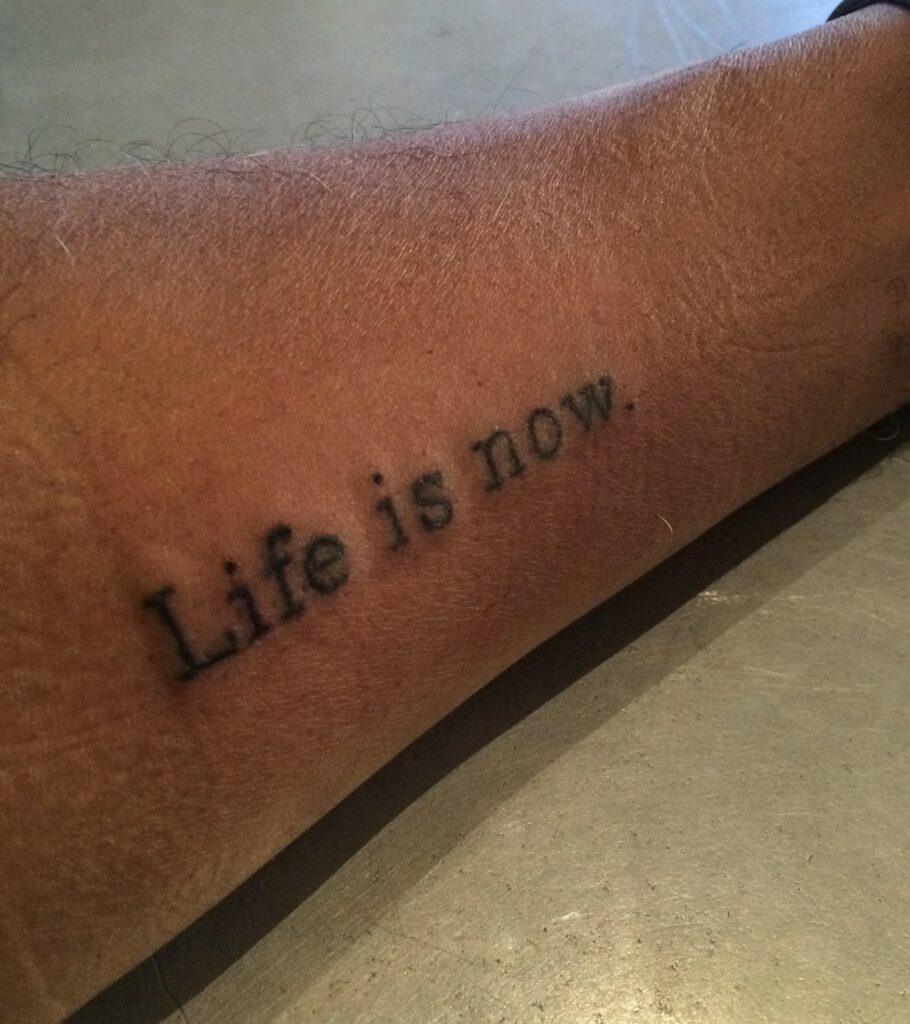
“Do I want the present moment to be my friend or my enemy?” ….Become friendly toward it, welcome it no matter in what disguise it comes, and soon you will see the results. Life becomes friendly toward you; people become helpful, circumstances cooperative….But that one decision you have to make again and again and again – until it becomes natural to live in such a way.”
Eckhart Tolle
What happened next still blows my mind when I think of it. I made friends with life and life made friends with me.
The LAPD investigation concluded that Laura did indeed panic when she saw the tag axle coming down. She tried to push our bike away and, in doing so, threw us off balance. I fell to the right and the motorbike came down on my leg. Laura fell to the left and in front of the rear wheels of the truck. Because I was found not to be at fault, my driver’s license was reinstated. My lawyer, after completing the investigation, choose not to charge me for his work.
My amazing niece, Michelle, started a GoFundMe and raised about $10,000, which allowed me to buy a car.
The huge thing: Someone in my family referred my case to the social services department at Cedars-Sinai. They ended up not charging for their services. I couldn’t believe it!
It wasn’t long before I was mobile again. I was again going on auditions. I was photographing electronic music events. But, I was also preparing to fulfil a promise.
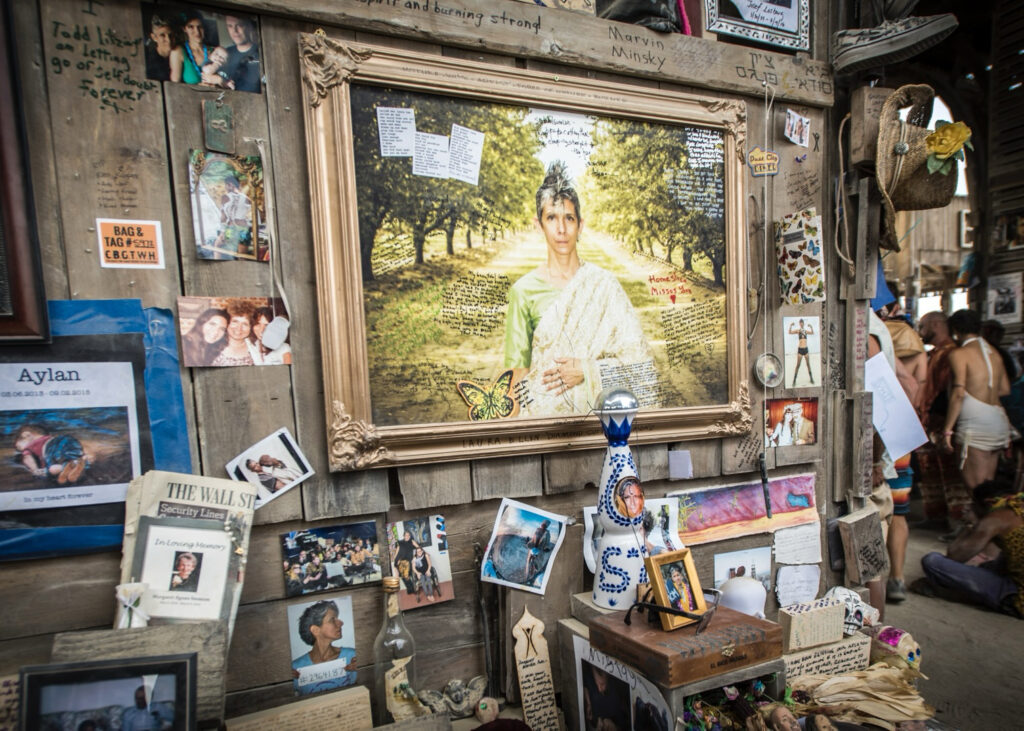
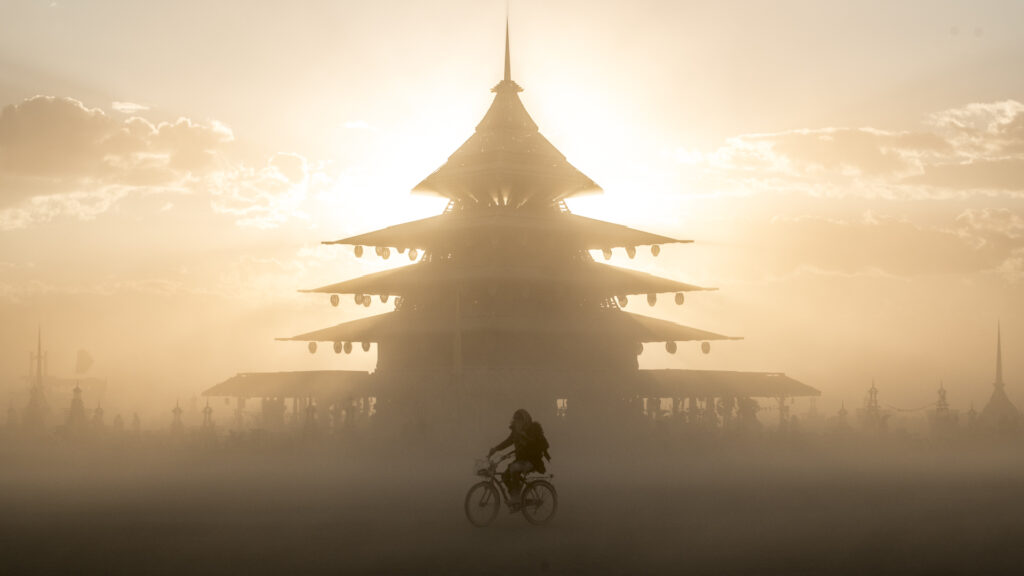
In 2016, I prepared to return to the Playa and take Laura’s remains to the Temple as promised. I ended up camping again with Que Viva! Camp. But, this time, I came as a camper, not a leader. I wanted make sure that I could experience the trip as fully as possible. My camp mates, who also loved Laura very much, happily obliged. Everyone was exceedingly kind.
Early on in the week, Blair introduced me to Temple builder David Best. I told David that Laura had a Burning Man tradition. Every year, she would make her way to the Temple on the sunday morning after the Man burn and watch the sunrise from there. David said, “Well then, let’s go find a nice spot for her, shall we?” We placed Laura on the eastern side of the Temple, with a clear view of the rising sun.
There was also time to think about the future. I had decided that that year would be my last Burn, for a while, at least. It had been 15 consecutive years. I wasn’t sure that I’d want to come back without Laura. And, Burning Man was changing. Whereas before, there was a connectedness in the population of Black rock city, the advent of social media, influencers, and overt commodification made “home” feel a lot less like home.
I also asked myself, did I really want to go back to the way things were in the default world? It seemed pretty clear that I probably not get that career-making role as an actor and it would probably still be a struggle. And as much as I enjoyed taking pictures of my Burner friends. Maybe there was something more, something I had never done before.
In my one-man show, Tales from the Playa, there is a section where I give “10 reasons NOT to go to Burning Man”, one of the reasons being that it’s so expensive: “For the money I spend on Burning Man, I could take a trip to Costa Rica or Thailand.”
Hmm. Thailand.
Thailand had been rolling around in my head for many years with out my realizing it. There was a Thai massage place in North Hollywood (It’s called Little House Spa and it’s still there!) that Laura and I went to when we had a little extra money. We both loved Thai food. In fact, there was a Thai restaurant right across the stree from out apartment. Of course, it was vegetarian, but still it was pretty good and not as expensive as was in some restaurants. This place also sold Thai coconut nectar drink. It comes in a brown bottle, a light sweet drink made from the coconut flower. It remains one of the most delicous drinks I have ever tasted. It was so refreshing that one year, I brought a case of it to Burning Man and gifted the bottles.
I thought, maybe that’s what I need to do. I had enough money. All of the big decisions I had made at Burning Man turned out to be good ones. So, it was at Burning Man 2016 that I decided to take the leap and travel to Southeast Asia.
On Sunday morning, I rode out to the Temple to take pictures. As the sun was coming up, a lone rider rode across the frame of my camera. Like Laura saying goodbye.
That evening, I said goodbye to Laura. It was my last time at Burning Man.